Facebook
 Google
 GitHub
 Linkedin
Sensibel’s MEMS Smart Optical Microphone Hits New Performance Peaks
The new mic offers an 84-dBA signal-to-noise ratio and a 146-dB acoustic overload point—a 10-dB improvement over the industry standard.
Sensibel recently announced a new optical MEMS microphone with industry-leading performance. The new SBM140B series comes with a wide, 136-dB acoustic dynamic range.
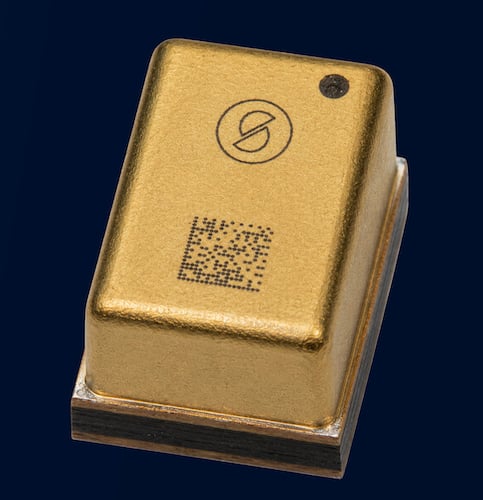
SBM140B series optical MEMS microphone.
Key sensing capabilities include an 84-dBA signal-to-noise ratio (SNR) and a 146-dB acoustic overload point (AOC)—a 10-dB improvement over best-in-class capacitive MEMS microphones. Its self-noise level is just 10 dBA, making it the “quietest MEMS microphone on the market.” The microphone is designed to deliver high-system-quality audio to mobile and miniature devices.
From Capacitive Sensing to Optical
Traditional MEMS microphones rely on sound pressure waves vibrating a metallic membrane. The membrane is in close proximity to a fixed, perforated electrode, forming a variable capacitor. A resistor turns it into an RC network. The sound waves are detected by the voltage across that RC network. The nature of RC circuits limits the dynamic range and response times due to charging and discharging times in the network. A typical capacitive MEMS microphone delivers an SNR between 65 and 73 and an AOP between 120 and 135.
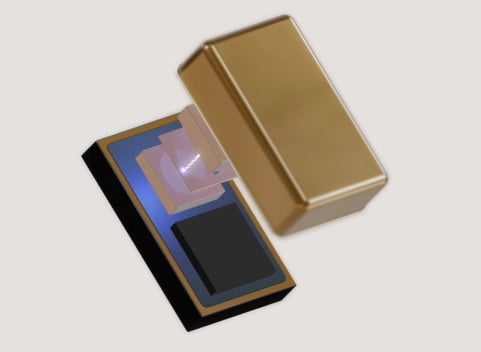
Optical MEMS microphone.
Optical MEMS microphones include a reflective membrane, a laser, and a photodetector to detect membrane displacement. A digital signal processing (DSP) ASIC converts the membrane movement into a compatible digital signal.
Optical MEMS microphones are a recent development pioneered by Sensibel. The optical membrane and laser system delivers improved precision and specifications over capacitive microphone technology. Rather than using capacitor charge and discharge as a response limiter, the limits are based on the digital system’s ability to measure the time-of-flight between the laser and the membrane.
Key Features and Applications: Striving for Studio Quality
Sensibel dubs the part as the “world’s lowest noise and widest dynamic range MEMS microphone.” Specifications behind that claim include a -46 dBFS (decibels relative to full scale) sensitivity at 94 dB and 1 kHz. It also features an equivalent input noise of 10 dBA sound pressure level (SPL) between 20 Hz and 20 kHz, with a 10-Hz low-frequency roll-off. This level of performance makes MEMS microphones a viable option for challenging audio applications such as drone detection, acoustic modeling, and more human-like hearing for robotics.
The part comes in three varieties, based on interface. The pulse density modulation (PDM) variety is aimed at phones, laptops, and true wireless stereo (TWS) earbuds. The I2S model operates with 24-bit or 28-bit resolution for pro and consumer audio applications, including studio settings. The third version communicates with up to eight channels of time-division multiplexing (TDM), which is better suited for microphone arrays in devices such as smart speakers and conference hubs. All three share the same performance specifications, an industry-standard bottom sensor location, and a 6 mm x 3.8 mm x 4 mm package.
Operation and Availability
The SBM140B operates on a 1.8-V supply voltage, making it well-suited for small devices and coin-cell power products. Designers can choose between maximum performance and maximum battery life. An optional I2C interface allows for further customization, including in-field configuration of bi-quad filters, digital gain, and sensor optimization.
Modern acoustic systems need to do more than just listen. Microphones have become part of sophisticated audio processing systems. Some of the more advanced applications include beamforming, source location, and audio matching. Reducing delays and distortion inherent in RC network-based microphones delivers a more accurate picture of the audio environment. Faster mic response and lower distortion in sensor arrays help ensure that sound variations are caused by the actual sound rather than by mic performance limitations.
Sensibel indicates that all three varieties will be available for volume shipping in Q1 2027.
All images used courtesy of Sensibel.
Related Content