Facebook
 Google
 GitHub
 Linkedin
Sensibel Eval Kits Support First Studio-Quality Optical MEMS Microphone
Announced today, the Aurora and Polaris development kits enable designs for the company’s studio-grade optical MEMS microphone.
Today, Sensibel advanced its optical MEMS microphone platform with the launch of the Aurora and Polaris development kits. Both platforms showcase the company’s SBM100B microphone, a device engineered to deliver condenser-level acoustic performance in a MEMS form factor.
All About Circuits spoke to Jakob Vennerød, co-founder and head of product development, and Mike Tuttle, head of applications engineering at Sensibel, to learn more firsthand.
SBM100B: Sensibel's Optical MEMS Microphone
The focal point of Sensibel's announcement is the SBM100B, a MEMS microphone that achieves an 80-dB signal-to-noise ratio and a 146-dB acoustic overload point, pushing its dynamic range to roughly 132 dB—more than 20 dB beyond the most advanced capacitive MEMS microphones. Importantly, the microphone achieves this range without forcing the traditional trade-off between noise floor and clipping point that has defined capacitive MEMS designs for decades.

Sensibel claims major improvements over capacitive MEMS solutions.
The microphone accomplishes this through a fully optical readout rather than an electrostatic one.
“We have a completely freely moving membrane that moves up to 40 micron. That gives us both the ability to eliminate this backplate noise and to measure very high sound pressure levels," said Vennerød. "We can measure 250 times stronger sound signals and five times lower noise, so we get an advantage in both ends, and we don’t have to do any trade-offs.”
It’s with these characteristics that Sensibel is targeting use cases involving far-field pickup, spatial audio capture, and high-intensity sound environments that exceed the useful range of capacitive sensors.
Optical MEMS Architecture and Its Impact on System Design
The significance of Sensibel’s optical approach becomes clearer when viewed in the context of what the company calls the “incremental progress ceiling” for capacitive MEMS. While smartphone camera modules have progressed from 2 MP single-lens units to multi-sensor 8K computational imaging systems, MEMS microphone performance has increased only from roughly 60-dB to 70-dB SNR over fifteen years.
“In capacitive technology, they've tried various tricks to get a bit more out of them, but they don't have a response, really," said Tuttle. "They're in the region of diminishing returns for the developments that they carry out.”
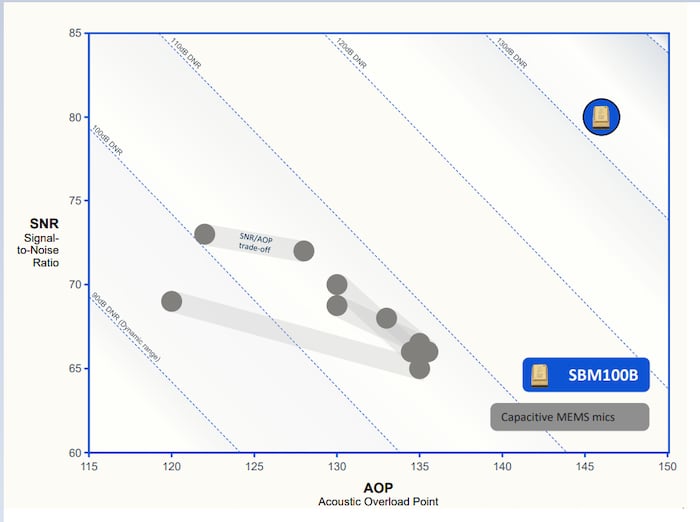
SNR vs. AOP for the SBM100B.
The optical MEMS structure breaks that limitation because the membrane no longer competes with a backplate for physical space, nor is the readout mechanism constrained by capacitance-to-noise ratios. Laser interferometry measures displacement with femtometer precision, enabling a noise floor near 14-dB SPL and maintaining linearity toward 146-dB SPL.
That spread ensures faithful reproduction of quiet acoustic environments while avoiding distortion in high-intensity conditions such as live performance venues or machinery-monitoring sound chambers. The optical module, ASIC, and MEMS membrane are integrated into a package roughly equivalent in size to conventional microphone housings, which means the system can drop into standard manufacturing flows while offering a performance class normally reserved for condenser microphones.
Another architectural benefit is uniform response. Optical detection avoids the part-to-part variability that plagues analog electret microphones and improves multi-element array coherence. According to Sensibel, this consistency strengthens beamforming efficiency because each microphone element preserves amplitude and phase alignment across the full bandwidth. These traits allow acoustic arrays to extend pickup distance, improve directional selectivity, or increase the accuracy of AI-based speech enhancement models.
Aurora: USB-Based Development for PDM and I2S Microphones
The Aurora development kit targets designers evaluating the SBM100B in applications that require stereo recording or integration with microcontrollers and embedded Linux systems. It operates as a USB Audio Class 2.0 interface capable of 24-bit capture at sample rates from 44.1 kHz to 96 kHz, which removes the need for an external audio codec. Aurora exposes both PDM and I2S microphone interfaces, and developers can toggle microphone gains using a hardware selector that issues predefined I2C writes. This enables quick acoustic characterization without constructing a full digital control path.
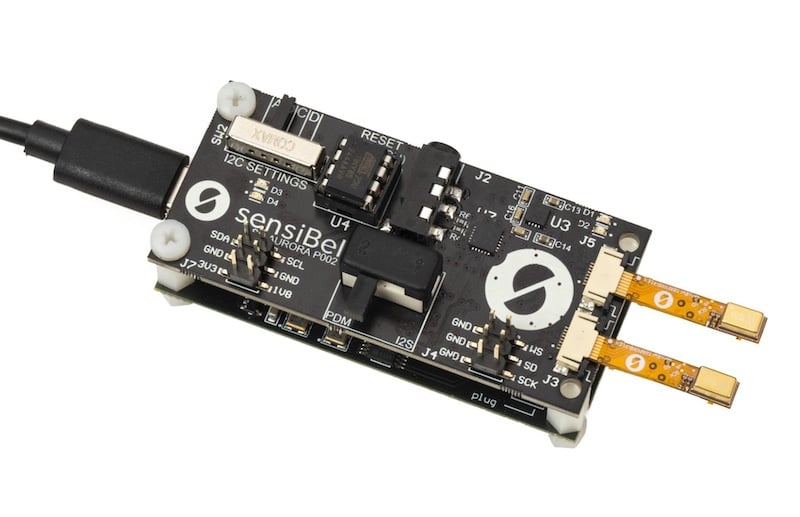
The Aurora development kit.
“With the Aurora kit, customers don’t have to build the physical piece of it themselves," Vennerød said. "All the hardware is done for you. You just have to plug it in.”
With real-time headphone monitoring, USB-powered operation, and no requirement for soldering or specialized lab tools, Aurora allows engineers to quantify noise floor, distortion behavior, and frequency response within minutes.
Polaris: Eight-Channel TDM Array for Beamforming and Spatial Audio
Polaris extends the evaluation environment to array-based applications. It integrates eight time-division-multiplexed SBM100B microphones into a circular geometry suitable for beamforming and spatial capture experiments. Each microphone is preconfigured with its own TDM timeslot, and the system converts the synchronized audio stream into eight aligned USB channels.
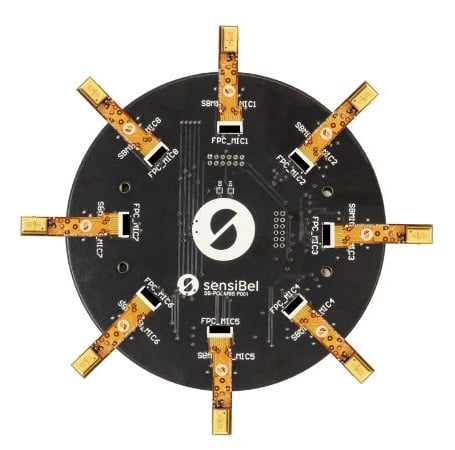
The Polaris development kit.
“Polaris uses our TDM microphone, where up to eight microphones can share the same data line. It’s a very scalable way of making these arrays," Tuttle explained. "If you didn’t have a TDM microphone, you could only group up to two PDM or I2S microphones on a single data line. So you’d end up with a lot of inputs to your host.”
By focusing on phase-matched elements, Polaris lets developers focus on algorithm development rather than calibrating or correcting hardware inconsistencies.
Early Market Impact
With Aurora and Polaris now available to selected customers, Sensibel expects the microphone’s performance to open pathways into mass-market consumer devices.
“After market entry, we aim to target specialist applications that really value high performance. In 2028 and beyond, we see ourselves in smartphones, ANC headphones, and automotive. It’s just a nice progression for us," Vennerød said. "Our first customers really do see the value in our microphone; it’s the only option for a lot of their applications.”
Go to Sensibel's product brief page to download more information about the SBM100B, Aurora, and Polaris.
All images used courtesy of Sensibel.