Facebook
 Google
 GitHub
 Linkedin
Infineon Rolls Out Self-Calibrating Hall Angle Sensors for Motor Control
The TLx49012 family computes its own error corrections on-chip, which Infineon says removes the need for external reference encoders during calibration.
Recently, Infineon introduced the XENSIV TLx49012, a family of four digital Hall-effect angle sensors for automotive and industrial motor control. As brushless DC (BLDC) motors spread through vehicles and robots, designers need accurate, low-latency rotor position feedback. Reaching that accuracy, however, generally requires manufacturers to calibrate each motor assembly against a reference encoder.
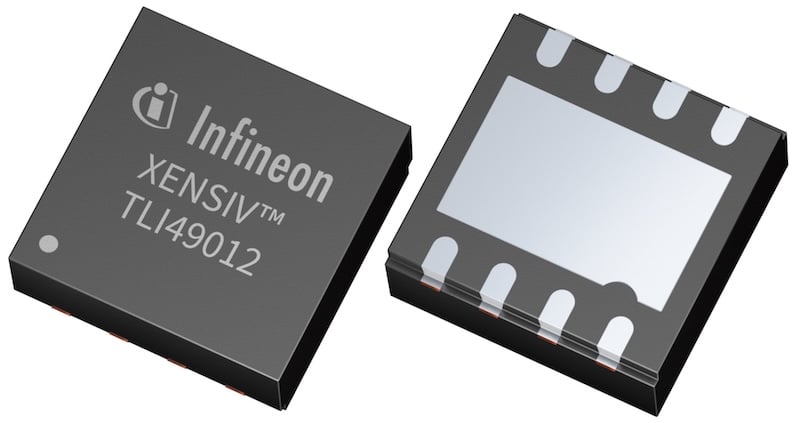
Infineon’s XENSIV TLx49012 digital angle sensor
Infineon designed the TLx49012 to calibrate itself, which the company says eliminates the reference encoder and custom calibration routines from production. By cutting that step, designers could bring closed-loop motor control to applications where conventional calibration would add too much cost or complexity.
The XENSIV TLx49012
Field-oriented control of a BLDC motor depends on accurate, up-to-date rotor angle measurements. Infineon offers the TLE49012 for automotive designs and the TLI49012 for industrial and consumer applications. Both devices combine two vertical Hall elements with an on-chip engine that outputs an absolute angle at up to 16-bit resolution. Designers can send that angle to the motor controller over SPI, ABZ, UVW, or PWM.
For high-speed drives, Infineon cites a 1.5 µs signal latency, while the datasheets specify a 2 µs maximum at constant velocity.
Speed aside, the family’s main differentiator is system self-calibration (SysCal). According to the datasheets, SysCal continuously calculates offset, ellipticity, and rotation corrections from the sensor’s X and Y signals. The algorithm derives those correction values over one to three shaft revolutions.
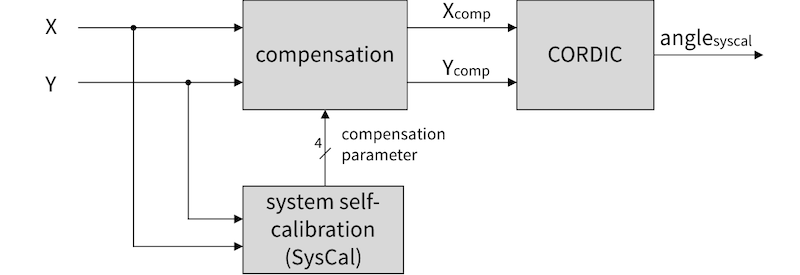
Block diagram of the TLx49012 system self-calibration
Those corrections cut the sensor’s specified angle error by more than half. With SysCal enabled, the datasheets list a maximum error of 0.1° at 25°C and 0.3° from −40 to +125°C. Without it, the maximum error rises to 0.7° over the same temperature range.
Infineon says the on-chip calibration removes the need for customer-developed routines and external reference encoders during end-of-line testing. The same correction scheme supports off-axis mounting, so designers can place the sensor beside the shaft instead of at its end.
Infineon also qualified the TLE49012 to AEC-Q100 Grade 0 and developed it for ISO 26262 requirements up to ASIL B(D). More information can be found in the data sheets for the TLE49012 and TLI49012.
Why Magnetic Angle Sensors Need Calibration
One major challenge in magnetic angle sensing is that real sensor signals rarely match the ideal. In principle, two-axis sensors measure the sine and cosine components of a rotating magnet’s field, then compute the angle with an arctangent function.
In practice, however, offsets, unequal channel gains, and imperfect axis orthogonality distort those signals, turning their ideal circular plot into a tilted ellipse. Researchers have modeled these nonidealities as DC offset, amplitude deviation, and non-orthogonal phase shift, each of which corrupts the calculated angle.
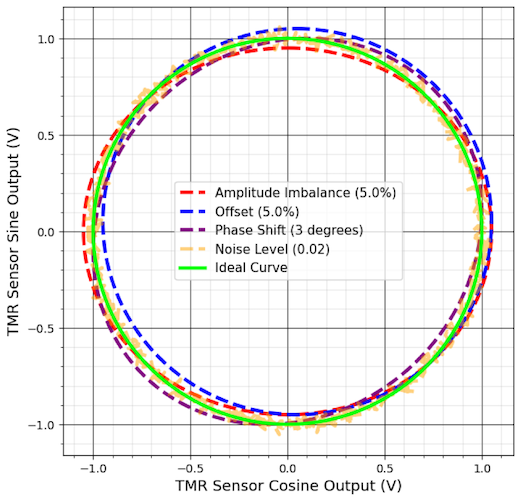
Lissajous plots show how amplitude imbalance, offset, phase shift, and noise distort the ideal circular sine/cosine response. Image used courtesy of Gerken and co-authors.
Mounting tolerances compound the problem. When designers place a sensor beside the shaft, the radial and tangential field components it sees generally differ in amplitude. That imbalance adds ellipticity on top of the sensor’s own errors.
For that reason, manufacturers have typically calibrated each assembly at the end of the production line. Technicians rotate the shaft against a high-accuracy reference encoder and record how far the sensor’s reading deviates from the encoder’s. They then program correction values, such as a look-up table, into the sensor or controller. Manufacturers reach their accuracy targets this way, but they pay for encoder hardware and cycle time at every test station.
Bringing Self-Calibration to Automotive and Industrial Drives
According to Infineon, the TLE49012 and TLI49012 are available now in a 3 × 3 mm PG-VSON-8 package. Infineon’s product pages list single-unit prices of $3.25 for the TLE49012 and $2.96 for the TLI49012. The product brief also lists two automotive variants with fewer interface options. For evaluation, Infineon offers TLE49012 and TLI49012 evaluation kits built around an XMC4700 platform, a rotary-knob add-on, and a GUI.
All images used courtesy of Infineon unless otherwise specified.
Related Content