Facebook
 Google
 GitHub
 Linkedin
Zuken Bakes AI Into PCB Design to Free Up Designers for Creative Tasks
The new CR-8000 2026 platform brings AI enhancements for schematic automation, real-time validation, and layout acceleration.
Zuken recently announced the CR-8000 2026 upgraded PCB design platform. The new platform aims to mitigate many PCB design challenges by bringing automation, intelligent acceleration, and reuse features to Zuken electronic design automation (EDA) software. The product utilizes AI and machine learning, along with more conventional automation.
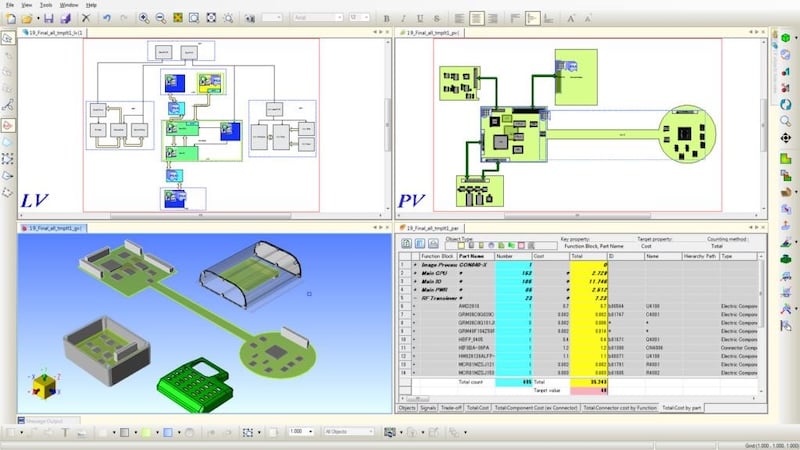
CR-8000 2026 System Planner.
AI PCB Design Philosophy
Designing printed circuit boards (PCBs) crosses multiple domains of expertise. Therein lies the challenge. Schematic design isn't the same skill set as signal integrity, EMC design, mechanical placement, and PCB layout, though today’s engineer is likely tasked with all of it. The alternative isn’t a lot better. When design and layout are split, a PCB layout expert must take a rat's nest and bill of materials (BOM) and turn it into a high-performing PCB without all of the information that lives in the original engineer’s head.
The high-end PCB design world does not yet seem ready to give the whole process over to AI, but AI can help make many parts of the process less painful. Zuken’s CR-8000 2026 seems to align with that philosophy. Zuken has added automation to virtually every step of the process.
Enhancements help with schematic routing, PCB rat's nest management, design segment reuse, validation, and place and route. The automation can evaluate for EMC issues and route based on signal standards. Much of the automation is AI-enhanced and augmented by machine learning—yet the designer remains in the loop and in control.
Key Features and Additions
CR-8000 functionality comes in modules. The System Planner module starts the architectural planning with multi-discipline upfront visualization.
Design Gateway covers schematic capture and, with the 2026 release, includes automated schematic routing. New AI tools automate component placement decisions and high-pin count connections. The tool uses AI augmentation to make design section reuse (from the current design or other projects) easier to manage and implement.
Design Force covers PCB layout, including multi-PCB layout, integrated circuit chip layout, constraint management, analysis, and MCAD collaboration. New to Design Force 2026 is Main Path View, which clarifies complex rat's nests and improves visibility across layers and sides.
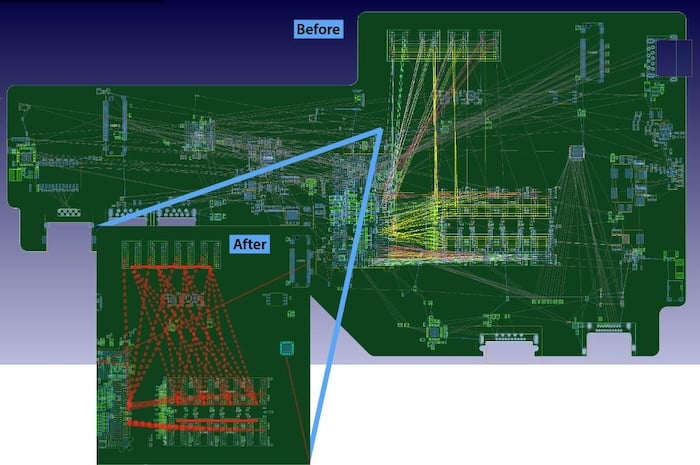
Enhanced rat's nest visualization in the early stages of PCB layout using the Main Path View feature.
Zuken calls their improved autorouter within Design Force the Autonomous Intelligent Place and Route (AIPR). They point out that it is not an AI router, but that it does utilize “AI-assisted and machine-learning capabilities alongside other intelligent automation methods.” It now includes a user-learning engine called the Dynamic Brain. It comes pretrained on Zuken’s libraries and reference designs. During use, it learns from the operator’s behavior and adds that knowledge to the automated place-and-route functionality.
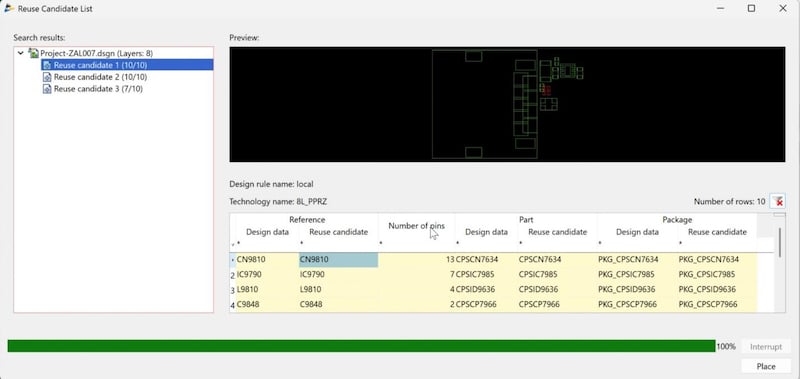
Dynamic reuse suggestions within AIPR.
Software Improvements to Reduce Design Pain Points
Schematic design is split between small sections of a circuit that require clever engineering and large circuit segments that consist of blatantly obvious pin-to-pin wiring. PCB routing comes down to a similar dichotomy.
The Design Gateway module in the new CR-8000 now includes what Zuken calls “signal standard auto-connect capabilities.” It learns from the design and component packages and automates much of the repetitive, obvious signal-to-signal connections. On the layout side, CR-8000’s mimic router learns from similar operations when routing circuits with a lot of repetition, like phased arrays and memory channels. The mimic router can take over these repetitive tasks without handing the entire job to an autorouter.
Making the Most of the Platform
Zuken’s CR-8000 2026 is built on the philosophy of using automation and AI to handle the error- and fatigue-prone drudgery of PCB design and layout, while letting the engineer focus on the creative parts that benefit most from intelligent human involvement. The 2026 version of CR-8000 is available now.
All images used courtesy of Zuken.
Related Content