Facebook
 Google
 GitHub
 Linkedin
Toshiba Employs Cortex-M4 MCUs With Motor PWM for Small System Control
The three TXZ+ entry-class M4H Group devices pair a 120-MHz Cortex-M4F with a +/-1% internal oscillator and an A-PMD motor-control block for 5-V consumer and industrial designs.
Toshiba has started mass production of three microcontrollers in its TXZ+ Family Entry-Class M4H Group. The TMPM4H4FYUG, TMPM4H2FYDUG, and TMPM4H1FYUG target small-scale system control in consumer equipment such as air conditioners and washing machines, and in industrial equipment such as multifunction printers and factory automation systems.

The M4H Group includes the TMPM4H4FYUG, TMPM4H2FYDUG, and TMPM4H1FYUG.
The announcement follows the June 2026 start of shipments of engineering samples. Toshiba positions the parts as entry-level devices for control logic, interface processing, and timing control, but each one still carries a floating-point Cortex-M4, a hardware motor PWM block, and an internal oscillator accurate enough to drop the external crystal in many designs.
Three Packages, One Feature Set
All three devices use an Arm Cortex-M4 core with a floating-point unit (FPU) and memory protection unit (MPU), running at up to 120 MHz. Each has 256 KB of code flash rated for up to 100,000 program/erase cycles, 18 KB of RAM with parity checking, and a 6 KB boot ROM. The product pages list a 2.7 V to 5.5 V supply range and an operating temperature range of -40°C to 105°C.
The 5-V capability is particularly important in this segment because appliance and industrial control boards often run from a 5-V rail, and an MCU that operates there directly can share a supply with sensors, gate drivers, and legacy logic without level shifting.
The three parts differ mainly in package and peripheral count:
| Variant | Packaging | I/O Ports | ADC Inputs | UART, TSPI | DMA Channels |
| TMPM4H4FYUG | 64-pin LQFP (10 mm x 10 mm, 0.5 mm pitch) | 51 | 12 | 4 UART, 4 TSPI channels | 32 |
| TMPM4H2FYDUG | 48-pin LQFP (7 mm x 7 mm, 0.5 mm pitch) | 37 | 10 | 3 UART, 2 TSPI channels | 27 |
| TMPM4H1FYUG |
44-pin LQFP (10 mm x 10 mm, 0.8 mm pitch) |
33 | 9 | 3 UART, 2 TSPI channels | 27 |
The 12-bit successive-approximation ADC converts in 0.73 µs at a 30-MHz conversion clock, according to the datasheet. Timing comes from six 32-bit timer/counter channels that can be split into 12 16-bit channels. The datasheet also lists standard I2C plus an enhanced I2C channel supporting Fast-mode Plus at up to 1 MHz. Toshiba says self-diagnostic features support functional safety requirements, and the datasheet details CRC32/CRC16 calculation, RAM parity, an oscillation frequency detector, a windowed watchdog, and an eight-level, low-voltage detector.
A 10-MHz Oscillator That Can Replace the Crystal
The M4H Group integrates a 10-MHz internal high-speed oscillator (IHOSC) that Toshiba specifies at +/-1% accuracy. The datasheet shows two such oscillators: IHOSC1, which is user-trimmable and can clock the system through the PLL, and IHOSC2, which runs the oscillation frequency detector and watchdog independently.
A conventional design would clock the MCU from an external crystal or ceramic resonator. The M4H still supports that, with an external oscillator input covering 6 MHz to 24 MHz. A crystal typically needs two load capacitors and careful layout near the MCU pins, and it uses two I/O pins. Removing it trims the bill of materials, frees board area, and eliminates a component sensitive to vibration and contamination.
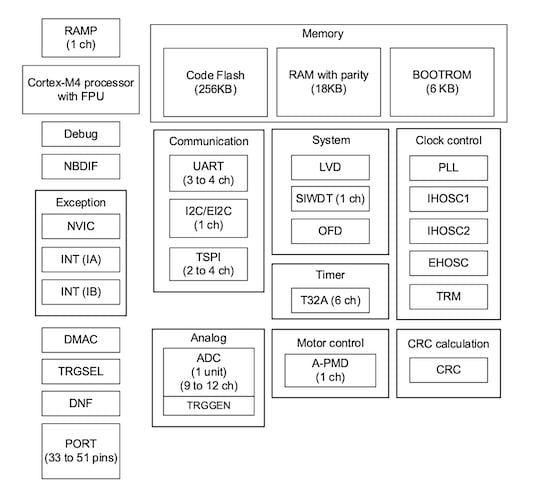
Block diagram of TMPM4H group.
The +/-1% figure is good enough for UART communication, timer-based control loops, and motor PWM generation in most appliance-class applications. It’s not a substitute for a crystal, though, where tight long-term frequency accuracy is needed. Toshiba's release says the oscillator cuts external component requirements and provides greater design flexibility. However, the datasheet doesn’t specify the temperature and voltage conditions behind that figure, so designers should confirm it against their own operating range.
Hardware Motor PWM at the Entry Level
Each device includes one channel of Toshiba's Advanced Programmable Motor Driver (A-PMD), which Toshiba says supports brushless DC (BLDC) motor control. According to the datasheet, A-PMD generates three-phase complementary PWM synchronized with the ADC, with emergency stop and overvoltage inputs that can force outputs to a safe state. It also supports three-phase interleaved power factor correction (PFC) control.
Toshiba's TXZ+ brochure describes A-PMD as handling dead-time insertion, per-phase carrier waveforms, and ADC triggering for phase-current measurement. Moving those functions into hardware keeps PWM timing and protection tight and independent of firmware, leaving the CPU to run commutation and the rest of the system logic. For example, in a washing machine or air conditioner, one MCU can run the user interface, sensor inputs, and a BLDC fan or pump motor.
The M4H Group sits below Toshiba's dedicated motor-control parts. The M4K and M4M groups, introduced in 2021, run at up to 160 MHz and add the A-VE+ vector engine and a 32-bit encoder circuit for field-oriented control of up to three motors.
All images used courtesy of Toshiba.
Related Content