Facebook
 Google
 GitHub
 Linkedin
Toshiba Debuts ‘Advanced Microstep Technology’ in New Motor Drivers
The new stepper motor driver adds advanced microstep control to reduce noise, vibration, and power consumption in compact motor systems.
Toshiba has introduced the TB67S579FTG driver IC to address some of the most prevalent issues with stepper motors.
Stepper motors are widely used in office and industrial equipment because they are easy to control and hold a position reliably. They often run with more vibration, noise, and current than necessary, especially at low speeds. Improving motion quality usually means increasing microstep resolution or adding control logic, which raises firmware complexity and processing load.
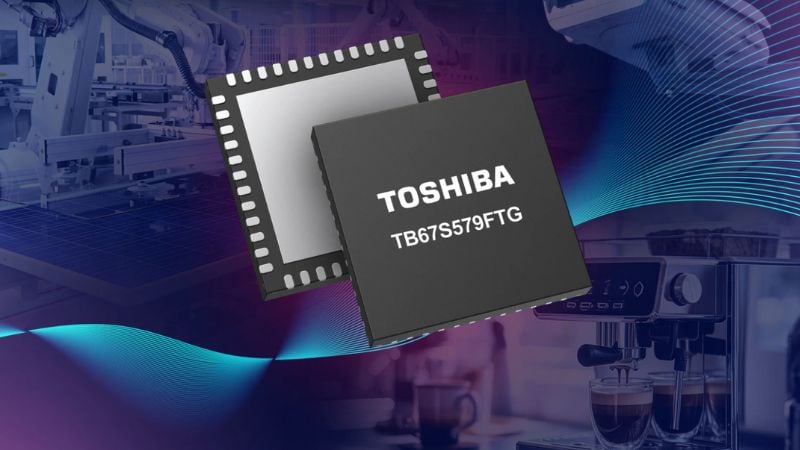
The TB67S579FTG addresses stepper motor noise and current draw directly inside the driver.
Toshiba's two-phase bipolar stepper motor driver integrates the company's unique "microstepping" and current-control functions intended to reduce vibration and power consumption without increasing the burden on the host controller. It is aimed at systems such as printers, scanners, ATMs, cameras, and other embedded motion applications.
Advanced Microstep Technology
The TB67S579FTG (datasheet linked) is Toshiba’s first stepper motor driver to use its Advanced Microstep Technology, which brings together second-generation Active Gain Control, the Automatic Wave Generation System, and Continuous Microstepping. Instead of driving the motor with discrete current steps, the device generates a smoothly varying current waveform inside the motor.
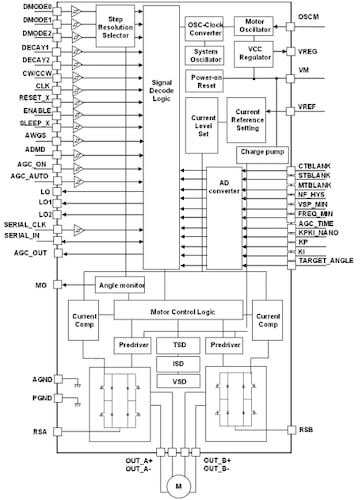
Typical block diagram for the TB67S579FTG.
This improves torque consistency while reducing vibration and audible noise, especially at low speeds. Because the driver handles current shaping internally, it avoids the need for tighter timing control or additional compensation logic in the host controller.
Driving Microsteps With a Single Clock Signal
Traditional microstepping methods require the input clock frequency to scale with the number of microsteps, which can complicate firmware and increase processor load.
Toshiba’s Automatic Wave Generation System avoids this by enabling microstepped operation using the same single clock signal normally used for full-step control. This streamlines the transitions between full-step mode for maximum torque and microstepping mode for quieter operation, all without altering control signals. This approach simplifies software design and reduces the controller's real-time processing demands.
Load-Adaptive Current Control
Active Gain Control (AGC) detects the motor’s induced voltage while it operates and uses this information to assess load conditions. The driver can automatically adjust the drive current, allowing the motor to operate at the minimum necessary current during light loads.
This process enhances overall efficiency, reduces power consumption, and maintains torque as demand increases. Additionally, AGC can refine the current waveform during full-step operation, thereby improving torque consistency.
Integration and Protection Features
The TB67S579FTG operates on a single motor supply from 4.5 V to 34 V, and supports output currents up to 2.0 A with a maximum voltage rating of 40 V. It has a typical RDS(on) of 0.6 Ω and a sleep current of no more than 1 mA. It integrates Toshiba's Advanced Current Detection System, eliminating the need for external current-sense resistors.
The on-chip charge pump reduces board space and component count by eliminating the need for external capacitors. It features dynamic mixed-decay control for higher speeds with reduced vibration and noise, as well as standard protection features such as overcurrent detection, thermal shutdown, undervoltage lockout, open-load detection, and stall detection.
The TB67S579FTG combines microstepping control, current management, and protection features in a single IC. Toshiba designed the TB67S579FTG driver for systems that need smoother motor operation while keeping external components and control complexity to a minimum, making it suitable for space- and cost-constrained stepper motor applications.
All images used courtesy of Toshiba.