Facebook
 Google
 GitHub
 Linkedin
Toshiba Adds Entry-Level MCUs to Portfolio for Secure System Control
Toshiba’s M4V Group MCUs combine an Arm Cortex-M4 core, layered security, integrated memory, motor control support, and built-in peripherals for secure IoT and industrial system control.
Toshiba Electronics Europe has announced engineering samples of the TXZ+ Family Entry Class M4V Group, a new set of microcontrollers for system control designs in industrial equipment, consumer products, and IoT devices.
The group is built around an Arm Cortex-M4 core with a floating-point unit operating at up to 80 MHz. That gives the devices enough processing headroom for control-oriented embedded systems without pushing them into a higher-cost or overbuilt MCU class.
The lineup includes four package options: the TMPM4V4FWUG in a 0.5 mm-pitch LQFP64 package, the TMPM4V2FWDUG in a 0.5 mm-pitch LQFP48 package, the TMPM4V2FWQG in a 0.5 mm-pitch VQFN48 package, and the TMPM4V1FWUG in a 0.8 mm-pitch LQFP44 package (datasheets linked).
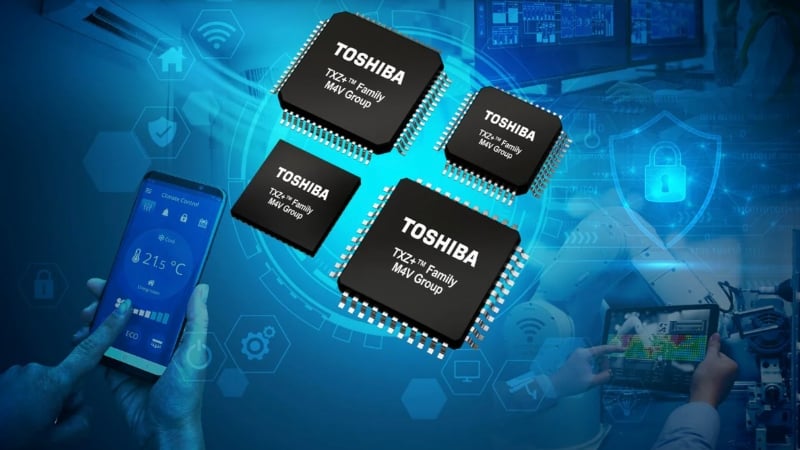
Toshiba’s TXZ+ M4V Group microcontrollers combine Arm Cortex-M4 processing, integrated memory, and layered security for industrial, consumer, and IoT control applications.
Each device integrates 128 KB of code flash memory, 64 KB of data flash memory, and 32 KB of RAM. The separate data flash matters because connected products often need to store configuration settings, logs, and update-related information without mixing that data with the main application code. That kind of memory separation can make software management cleaner over the product lifecycle for equipment that may stay in the field for years.
Built for Connected Equipment
The M4V Group is designed for embedded systems that now need more than basic control. Appliances, factory automation equipment, pumps, motors, inverters, remote monitoring devices, and security equipment are all becoming more connected. That puts new pressure on the controller. It still has to handle timing, sensing, and communication, but it also has to support secure updates, protected data storage, and stable operation after deployment.
That is where the M4V Group’s security structure becomes the central story. Toshiba describes the devices as using a multilayered security architecture that combines external access control, memory protection, and execution control. The specific security functions include chip protection, secure access memory, and non-releasable flash protection. Together, those features are intended to help guard against unauthorized access and program tampering.
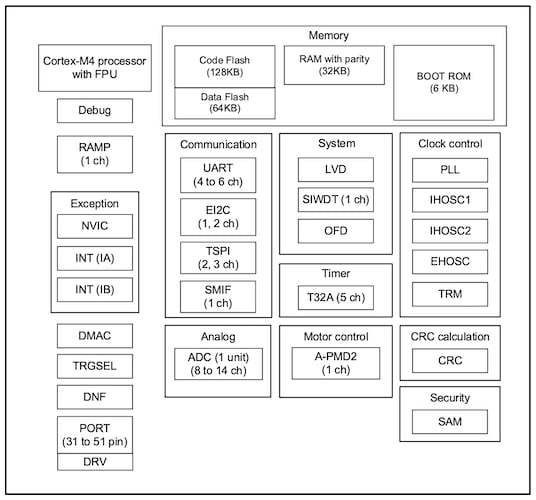
Block diagram of TMPM4V group.
That’s a great detail for IoT equipment because the MCU is often the control point between the physical machine and the connected network. Once OTA updates, remote configuration, or field data logging come into the picture, the software stored on the device can become a target.
A layered approach helps designers protect different parts of the system instead of relying on one security mechanism to do everything. Access control helps limit who can reach the device. Memory protection helps guard stored software and data. Execution control helps reduce the risk of unauthorized or altered code running on the system.
Integrated Control Peripherals
Beyond security, the M4V Group includes the peripheral set expected in compact system control designs. The devices integrate a 12-bit analog-to-digital converter, timers, UART, SPI, I²C, and DMA. Depending on the package option, the lineup includes different counts of I/O, communication channels, external interrupt pins, and ADC channels, giving designers some room to choose a package around the actual system footprint.
The group also includes Toshiba’s Advanced Programmable Motor Driver, or A-PMD2, for brushless DC motor control. This makes the devices useful in systems where the MCU not only handles sensing and communication but also directly supports motor control functions. In appliances, pumps, fans, and industrial motion equipment, this can reduce the need for a separate control device dedicated only to the motor stage.
A Serial Memory Interface is also built in. The SMIF allows direct access to external serial flash memory mapped into the address space, which can be useful when the system needs more storage for firmware, logs, or application data. Because dedicated hardware handles access, the design can reduce CPU involvement during memory operations and support more efficient data handling.
Reducing External Components
The M4V Group also targets board-level simplification. The devices operate from a 2.7 V to 5.5 V supply range, making them easier to integrate into different embedded systems without requiring a narrow supply architecture. They also include an internal high-speed oscillator with ±1% accuracy.
That oscillator is one of the clearer component-reduction features. In many embedded designs, an external oscillator or resonator adds cost, board space, and sourcing complexity. By integrating a sufficiently accurate internal clock source, the M4V Group can eliminate that external part in systems where the internal oscillator meets the timing requirements.
The same pattern shows up across the device. Code flash, data flash, RAM, communication peripherals, ADC functions, DMA, motor control support, self-diagnostic functions, and external memory access are all brought into the MCU. That doesn't remove every external part from a finished design, but it puts more required system control functions inside one IC.
Where the M4V Group Fits
Toshiba positions the M4V Group for broad system-control applications, including connected appliances, industrial equipment, motors, pumps, factory automation systems, security equipment, servers, and remote monitoring devices. To support development, Toshiba provides starter kits, sample software, CMSIS-compliant drivers, and major IDE support.
Overall, the M4V Group gives engineers an entry-level MCU option to add connectivity, security, memory management, and control features without expanding the hardware design more than necessary.
All images used courtesy of Toshiba.