Facebook
 Google
 GitHub
 Linkedin
STMicro Unwraps Context-Aware Sensors Built With Sustainable Materials
The LSM6DSK320X and ISM6HGK256X combine low-g and high-g measurement in a 2.5 mm x 3 mm package using lead-free, BPA-free materials.
STMicroelectronics has released two new 6-axis inertial measurement units that integrate dual accelerometers, a gyroscope, and an embedded machine-learning core in a single package built with sustainable materials.
The LSM6DSK320X targets consumer applications, while the ISM6HGK256X is designed for industrial use with a wider temperature range and a 10-year longevity commitment. Both sensors are part of ST's Sustainable Technology framework and use lead-free, BPA-free materials throughout.
The devices address a specific limitation in conventional IMU designs. Applications such as drone flight stabilization, concussion detection, and industrial vibration monitoring need both fine-grained low-g measurement for steady-state motion and the ability to capture sudden high-g shocks without saturation.
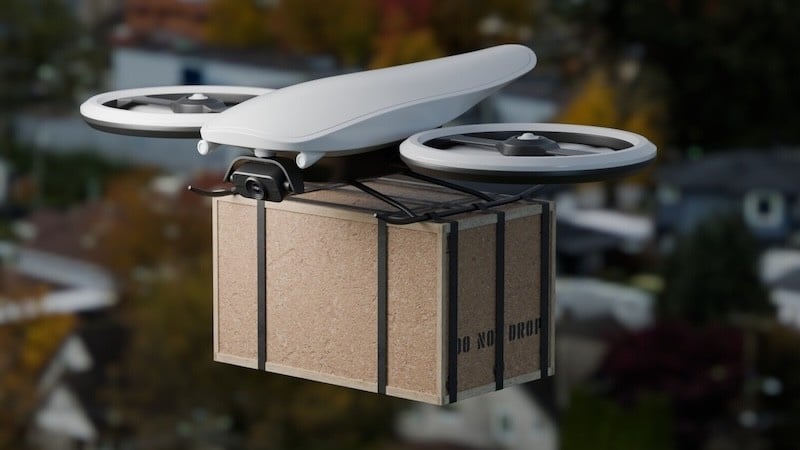
The new sensors are well suited for systems like drones for flight stabilization.
Traditional single-accelerometer IMUs force engineers to either pick one measurement range or switch modes on the fly, creating data gaps during transitions. ST's dual-accelerometer architecture eliminates that by running both measurement channels simultaneously.
Dual Accelerometer Architecture
Both IMUs integrate a low-range accelerometer and a high-range accelerometer alongside a three-axis gyroscope, all within a 2.5 mm x 3 mm x 0.83 mm LGA-14L package. The low-g accelerometer offers selectable full-scale ranges of +/-2, +/-4, +/-8, and +/-16 g. The high-g accelerometer extends to +/-32, +/-64, +/-128, +/-256, and +/-320 g on the LSM6DSK320X.
The gyroscope provides selectable ranges from +/-250 to +/-4,000 degrees per second, covering everything from slow rotational tracking in wearables to fast angular rate measurement in drone stabilization and robotics.
ST employs what it calls a "super-symmetric gyroscope architecture" with mirrored electromechanical structures operating in counter-phase. This design cancels external vibrations and mechanical shocks at the MEMS element level, improving measurement stability in environments with persistent mechanical noise.
Power consumption is 0.67 mA in 6-axis high-performance mode and 0.80 mA in 9-axis mode, while the smart FIFO buffer provides up to 4.5KB of storage with compression support, and the sensors communicate over SPI, I2C, and MIPI I3C v1.1 interfaces.
The consumer-grade LSM6DSK320X operates from -40C to 85C and is priced at $4.60 per unit in quantities of 1,000. The industrial ISM6HGK256X extends the operating range to 105C, is priced at $5.10, and is enrolled in ST's 10-year longevity program for industrial customers who need guaranteed long-term supply. More information is available in the data sheets for the LSM6DSK320X and the ISM6HGK256X.
On-Sensor AI and Developer Ecosystem
Both IMUs embed ST's machine-learning core, which runs classification and pattern-recognition algorithms directly on the sensor die. This allows the host processor to remain in a low-power state while the sensor handles context detection tasks such as activity recognition, fall detection, or vibration signature classification. For battery-powered devices, offloading these workloads to the sensor can meaningfully extend operating time.
The sensors also include a programmable finite state machine that runs at rates up to 960 Hz, a sensor-fusion low-power algorithm for orientation tracking, and an adaptive self-configuration feature that automatically adjusts power modes based on activity context. These processing elements work in concert: the FSM handles deterministic threshold-based decisions while the machine-learning core handles more complex pattern recognition.
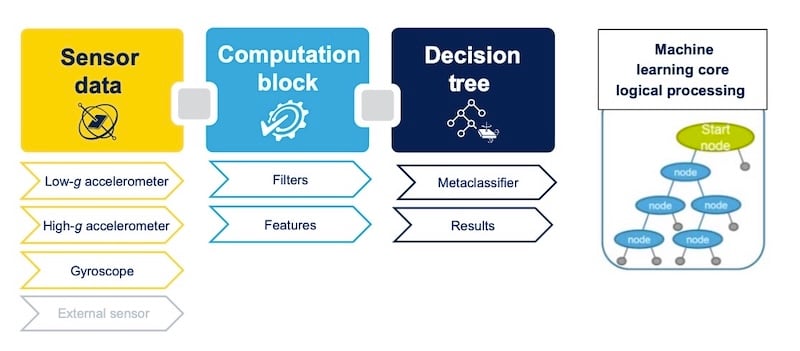
Machine learning core in the ISM6HGK256X
Development support comes through ST's MEMS Studio environment, which provides tools to configure sensor parameters and train machine-learning models for the MLC, as well as validating sensor-fusion outputs. ST also provides its Motion XLF libraries and sensor-fusion software packages.
Sustainable Materials and Availability
Both sensors carry ST's Sustainable Technology label, meaning they’re manufactured using lead-free and BPA-free processes and materials. ST says the material changes were implemented through modified process chemistry without compromising the sensors' electrical performance, power consumption, or mechanical robustness.
The sustainability angle is increasingly relevant as regulatory pressure around hazardous materials tightens in the European Union and other major electronics markets. Designing sustainability at the component level enables system integrators to meet environmental compliance requirements without identifying and re-qualifying alternative parts further downstream.
All images used courtesy of STMicrolectronics.