Facebook
 Google
 GitHub
 Linkedin
SiTime Reveals MEMS Timing Device for AI Data Center GPU Optimization
The MEMS-based oscillator delivers less than 1 nanosecond of time synchronization accuracy for AI clusters.
Recently, SiTime announced their newest MEMS-based temperature-compensated oscillator. Dubbed the Elite 2 Super-TCXO, the new solution is said to to improve GPU utilization by reducing time synchronization error in compute clusters, the new solution, All About Circuits sat down with Jeff Gao, VP and GM of Datacenter-Communication Business at SiTime, and Gary Giust, PhD, Director of System Architecture at SiTime, to learn more firsthand.
Elite 2 Super-TCXO
According to SiTime, AI cluster synchronization stands today at roughly 1 microsecond, but, as AI demands grow, hyperscalers have begun targeting 10 nanoseconds across all GPUs in a single cluster. Based on their calculations, reaching that target entails a 100-fold reduction in timing error, meaning the oscillator must contribute well under 10 percent of the cluster's overall timing budget.
As Gao explains, "The TCXO oscillators have a very, very critical role to play in helping the cluster to improve the overall utilization of the GPUs by improving the accuracy of the synchronization architecture, where the GPUs will have a much tighter notion of what time really is in relation to each other."
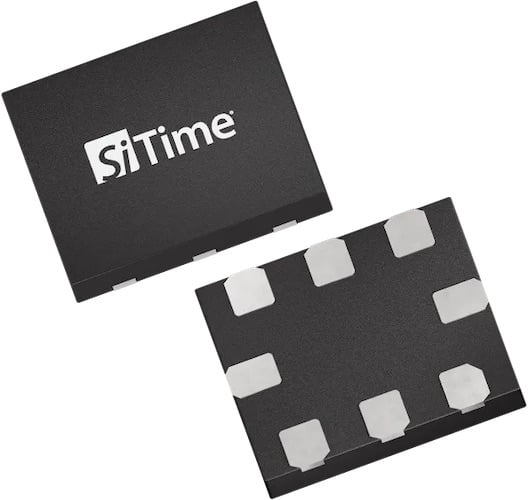
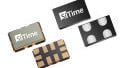
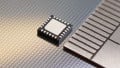
Elite 2 Super-TCXO package.
To that end, the new device delivers less than 1 nanosecond of time synchronization accuracy, equating to timing error below 10 percent of the 10 nanosecond target. Speicifcally, SiTime specifies the Elite 2 at ±2 ppb/°C for the frequency temperature slope (dF/dT), 6 x 10⁻¹² for Allan deviation (ADEV), and ±50 ppb frequency stability over −40 to 105°C, all in a 3.2 x 2.5 mm footprint drawing 22 mW. By comparison, according to SiTime, competing TCXOs on the market today contribute 90 to 450 nanoseconds to synchronization error.
Framing the broader cost of timing imprecision in a distributed cluster plainly, Giust tells us, "Distributed AI is a distributed system at the very heart of it, and distributed systems distribute tasks based on time slots. The more uncertainty you have in what those timestamps are, the more the system needs to wait out that uncertainty, and that's an inefficiency."
Thermal Stability Under Data Center Conditions
Reaching the 10 nanosecond target inside an actual AI server requires the oscillator to hold its accuracy under thermal conditions that differ substantially from historical design assumptions. According to Gao, board-level operating temperatures that engineers once planned around, typically 45 to 55°C, have since climbed as high as 85°C, with some deployments targeting 95 to 105°C over extended periods.
Meanwhile, the rate of temperature change compounds the challenge. AI servers throttle GPUs and duty-cycle hardware, with the very real possibility of of 5 to 20°C temperature swings in quick succession. As Giust explains, "When GPUs turn on quickly, they'll generate a lot of heat that couples through the PCB traces to the oscillator. That's where this gradient can occur. We want to ensure the output stays stable in between updates from the network to keep the client time very accurate."
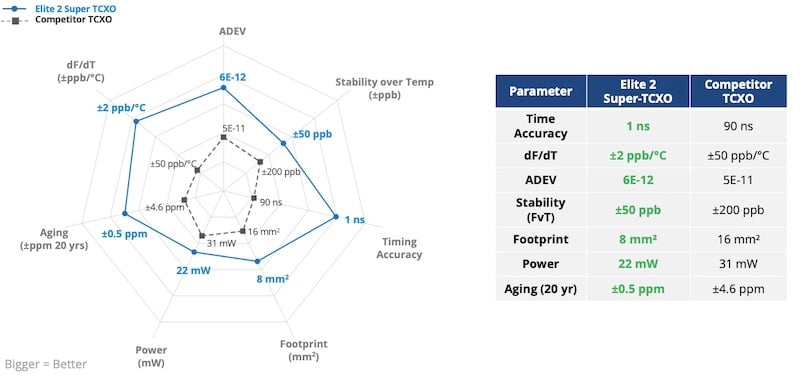
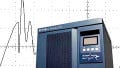
Elite 2 outperforms competition in performance.
For that reason, SiTime designed the Elite 2 to maintain its accuracy through these conditions using two interacting specifications. The dF/dT spec of ±2 ppb/°C quantifies how much the output frequency shifts per degree of temperature change, and the ADEV of 6 x 10⁻¹² characterizes the oscillator's inherent short-term noise floor. According to the company, both parameters together enable sub-nanosecond performance across the device's full operating range.
The technology behind both figures is SiTime's DualMEMS architecture. As Gao tells us, "The fact that we have MEMS expertise, analog expertise, and packaging expertise under the same roof allowed us to develop products so far ahead of the competition…DualMEMS technology allows us to measure the temperature directly over the resonator.”
Whereas quartz implementations usually place the sensor below the resonator, SiTime is able to achieve tight coupling that lets them correct for temperature fluctuations very accurately.
Deployment and Availability
SiTime is initially targeting two locations in AI clusters.
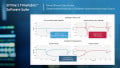
In a SmartNIC, the device will work alongside a clock buffer to maintain the synchronization chain that manages traffic control across the network fabric. On the compute board, the Elite 2 will connect to CPU socket and hold the timing reference while GPUs execute compute tasks.
Looking to the future, Gao only sees a greater need for such solutions.
"The higher the speed in the future, the tighter the synchronization needs to be.”
The Elite 2 Super-TCXO is sampling now, with commercial production scheduled for Q3 2026.
All images used courtesy of SiTime.