Facebook
 Google
 GitHub
 Linkedin
Nuvoton Rolls MCU Blending 24-bit ADC and Analog Front End
The Cortex-M23 microcontroller pairs metrology-grade signal acquisition with an LCD driver and Class-D voice output in a single LQFP128 package.
Nuvoton Technology has launched the NSC128L42, a 32-bit Arm Cortex-M23 microcontroller built around a 24-bit sigma-delta analog-to-digital converter for high-precision measurement. The device combines metrology-grade signal acquisition, an LCD driver, and voice synthesis in one package aimed at portable and industrial products such as blood pressure monitors, precision scales, and other measurement instruments.
The company is selling analog integration as the chip's main use case, where a typical measurement design pairs a low-cost microcontroller with an external precision ADC and a discrete amplifier stage. The NSC128L42 pulls those functions onto the die, reducing external component count and board area for cost-sensitive, high-accuracy applications.
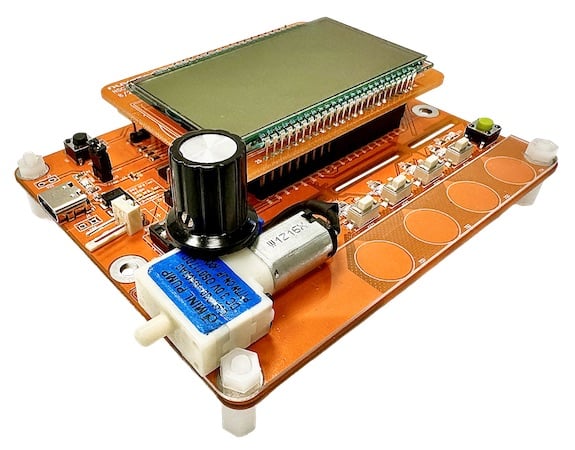
The NSC128L42EVB is an evaluation board for the new NSC128L42 MCU.
A Metrology-Grade Analog Front End
The primary feature of the NSC128L42 is a 24-bit sigma-delta ADC for ultra-high-resolution signal acquisition, sampling at up to 500 Hz. That low bandwidth is deliberate, targeting slow-moving, DC-precision measurements such as weigh-scale and biomedical signals rather than fast waveforms. Alongside it sits a 12-bit SAR ADC running at up to 200 ksps with five external and three internal channels for faster general-purpose conversions.
Feeding the converters is a bridge-sense front end built for load cells and precision sensors. It includes an integrated instrumentation amplifier with selectable gain from one to 128 times, chopper stabilization to suppress low-frequency noise, and on-chip references comprising a bandgap reference, an adjustable 1.5 V to 4.5 V LDO, and a VMID reference. A separate operational amplifier that can also serve as a comparator rounds out the analog block, further cutting the need for external circuitry.
Signal conditioning continues in the digital domain through a six-stage cascaded biquad filter, equivalent to a 12th-order IIR filter with 19-bit coefficient precision. The filter can process the sigma-delta ADC path or run independently, with FIFO buffering and DMA support to keep the core free.
This maps closely to the designs Nuvoton is targeting: a load-cell weight scale needs a high-gain, low-noise amplifier to lift the millivolt bridge output, a high-resolution converter to resolve small weight changes, and digital filtering to reject mains interference. Blood pressure monitors, pulse oximeters, and precision kitchen and body-fat scales place similar demands on the front end, and handling that acquisition on-chip removes the external ADC and amplifier that a discrete design would otherwise carry.
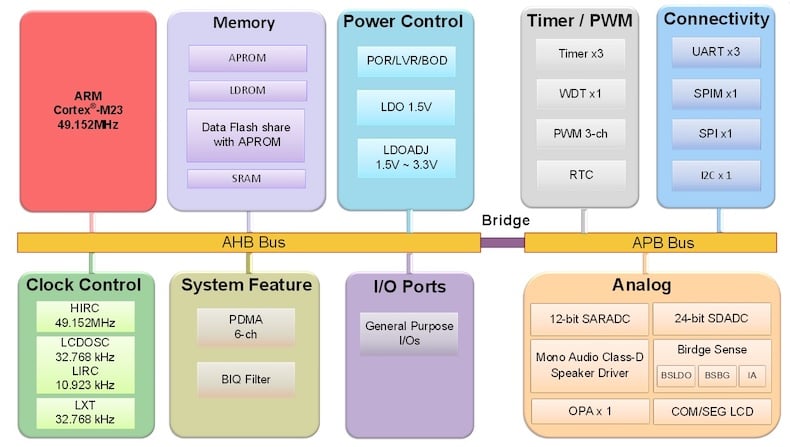
NSC128L42P MCU block diagram
Compute, Memory, and Connectivity
The Cortex-M23 core runs at up to 49.152 MHz across a wide 2.0 V to 5.5 V supply range, with an internal high-speed RC oscillator rated to 1% accuracy. On-chip memory comprises 320 KB of flash, an additional 6 KB loader ROM that can be configured as an ISP bootloader, and 18KB of SRAM. The device ships in a 128-pin LQFP with 68 GPIO and an operating range of -40 ℃ to 85 ℃.
Integration extends well beyond analog, with an LCD driver supporting configurations up to 8 common by 44 segment lines, or 352 dots, with a built-in charge pump for display bias. A Class-D speaker driver delivers up to 0.35 W at 3.6 V into an 8 Ω load, enabling voice prompts and audio alerts, a capability that reflects the part's origins in Nuvoton's Audio SoC line. Up to four capacitive touch channels, an RTC, three timers, and 14-bit PWM outputs fill out the peripheral set, covering most of the human-machine interface a handheld instrument needs without a companion chip.
Communications include three UART interfaces, an SPI controller supporting transactions up to 64 bits, a quad-capable SPIM flash interface, and a Fast-mode-plus I2C port rated to 1 Mbps. A six-channel DMA controller moves data between those peripherals and the ADCs without core intervention. For manufacturers building regulated medical and metering devices, the part also carries a 96-bit unique ID and a 128-bit customer ID for traceability, along with a serial-wire debug interface and both in-system and in-circuit programming. More information is available in the NSC128L42 data sheet.
Low-Power Operation and Availability
For battery-powered instruments, the NSC128L42 offers several low-power states, including a deep power-down mode drawing less than 1 µA. An internal low-speed RC oscillator drives periodic wake-up, letting a device monitor events, from an RTC alarm, timer, GPIO edge, or watchdog, while keeping average consumption low. A brown-out detector with 16 programmable trip points from 1.8 V to 4.6 V and a low-voltage reset guard against supply faults.
The clocking also keeps the bill of materials small. The 49.152 MHz high-speed RC oscillator is accurate to 1%, tight enough to run the UARTs without an external crystal, while separate low-frequency oscillators handle the LCD and watchdog, and a 32.768 kHz crystal input remains available where the RTC needs better long-term accuracy.
The NSC128L42EVB eval board supports the NSC128L42P, NSC128L42Y, and NSC128L42S variants with CAN FD, EBI, and Arduino Uno connectivity for prototyping.
All images used courtesy of Nuvoton.