Facebook
 Google
 GitHub
 Linkedin
Nordic Debuts Wireless Edge AI SoC Boasting 20x Lower Standby Power
The nRF7120 and nRF7120E combine a 256-MHz Cortex-M33 host, two independent radios, and an Axon neural processing unit for battery-powered Wi-Fi devices.
Nordic Semiconductor announced the nRF71 series, a family of wireless SoCs that put Wi-Fi 6, Bluetooth LE, Thread, and a 256-MHz Arm Cortex-M33 application processor on a single die. The Oslo-based company says the first two parts, the nRF7120 and nRF7120E, cut standby power by up to 20 times compared with its current nRF70 series of Wi-Fi devices. The nRF7120E also adds an Axon neural processing unit for running machine-learning models on the device.
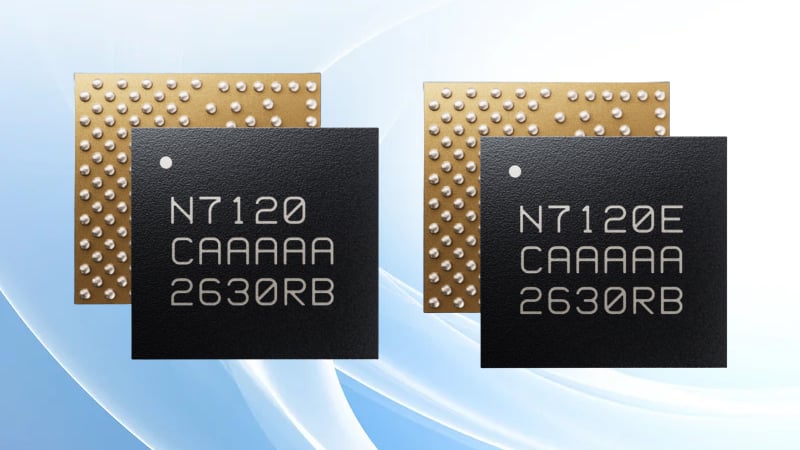
The two parts in the nRF71 series.
The nRF70 series parts that preceded them, including the widely used nRF7002, were Wi-Fi companion ICs that required a separate host MCU such as the nRF5340. The nRF71 series folds the host into the radio chip.
Edge AI on the Chip
The Axon NPU on the nRF7120E runs at 256 MHz and, according to Nordic, executes machine-learning models 10–17 times faster than the Cortex-M33 alone. The company names keyword spotting, anomaly detection, and image classification as representative use cases. The intent is for the device to process raw sensor or microphone data locally and send only the result over Wi-Fi, keeping the radio asleep longer.
Kjetil Holstad, executive vice president for Wi-Fi and power management at Nordic, said the company expects edge AI to become part of every connected device and that the nRF71 series brings Wi-Fi and edge AI onto the same ultra-low-power platform and tools that developers already use for Bluetooth LE.

Block diagram of the nRF70 series.
The dual-band nRF7120 omits the NPU but still supports edge AI through Neuton, the automated tinyML tooling Nordic acquired in June 2025. Neuton generates very small models from a developer’s data, sized to run on the Cortex-M33 without acceleration. Models on either part can be updated over the air through nRF Cloud. A RISC-V coprocessor, also clocked at 256 MHz, handles Nordic’s SoftPeripherals, which emulate interfaces such as SDIO and CAN 2.0B in software.
Two Radios and One Host
The application processor delivers 1,010 CoreMark (3.95 CoreMark/MHz) and includes 4 MB of on-chip non-volatile memory, 1 MB of user-accessible low-leakage RAM, a dedicated DFU slot, and support for in-place execution from external flash.
The Wi-Fi radio supports 802.11a/b/g/n/ac/ax in station and SoftAP modes. The nRF7120 covers 2.4 GHz and 5 GHz; the nRF7120E adds the 6-GHz band for Wi-Fi 6E. Maximum transmit power is 21 dBm at 2.4 GHz and 22 dBm at 5 GHz and 6 GHz, with receive sensitivity of -98.6 dBm at 1 Mbps. Power saving relies on Target Wake Time and legacy power-save mode with a low-power receive path. Nordic specifies connected-standby current at DTIM10 of 14 µA at 2.4 GHz and 8 µA at 5 GHz, measured at 3.6 V, and sleep-mode currents between 1.44 µA and 4.68 µA.
The second radio is the 2.4-GHz multiprotocol block from the nRF54 series, covering Bluetooth LE up to 4 Mbps with 10-dBm output and -99-dBm sensitivity; Thread and Zigbee over 802.15.4 at -102-dBm sensitivity; Matter; Bluetooth Channel Sounding; Bluetooth Mesh; Aliro; and proprietary 2.4-GHz protocols. Because the two radios have separate RF and baseband blocks, both can receive simultaneously, so a Matter bridge or Thread border router can hold its Wi-Fi association while listening for 802.15.4 traffic.
Fewer Parts on the Board
The nRF71 series removes several components that an nRF70-based design needed. The host MCU is gone, as is the external flash for application code in most cases, given the 4 MB of on-chip NVM. The 2.8 V to 5.5 V supply range spans a single lithium-ion cell from full charge to cutoff, and it supports high-speed USB with an integrated PHY rather than an external transceiver. The chip exposes up to 65 GPIOs, four 64-MHz SPI ports, a 4-Mbps UART, six 8-MHz SPI/TWI/UART blocks, and ADC, TDM, PDM, PWM, and quadrature decoder peripherals.
The bare die ships in a 4.9 mm x 4.6 mm WLCSP at 350-µm pitch, and the nRF7120 and nRF7120E are pin-compatible. For designs that want to skip RF layout, the 14 mm x 10 mm nRF7120 module integrates the matching network, filtering, transmit/receive switch, diplexer, 64-MHz crystal, shielding, and a PCB antenna, with modular certification planned for FCC, CE, and Japan. Both the module and the nRF7120-DK development kit are listed as "in preparation."
Software support comes through nRF Connect SDK, shared with the nRF70 and nRF54 series. Operating temperature is -40°C to 85°C.
All images used courtesy of Nordic Semiconductor.