Facebook
 Google
 GitHub
 Linkedin
Melexis Adds 5V Pico-Resolver for Space-Constrained Motor Designs
The new device pairs Triaxis Hall sensing with analog sine and cosine outputs in a 2.0 mm x 2.5 mm package aimed at through-shaft and side-of-shaft actuators.
Melexis has introduced the MLX90381 5V, a 5V-supply version of the Triaxis magnetic pico-resolver that the Belgian sensor maker launched as a 3.3-V device in 2022.
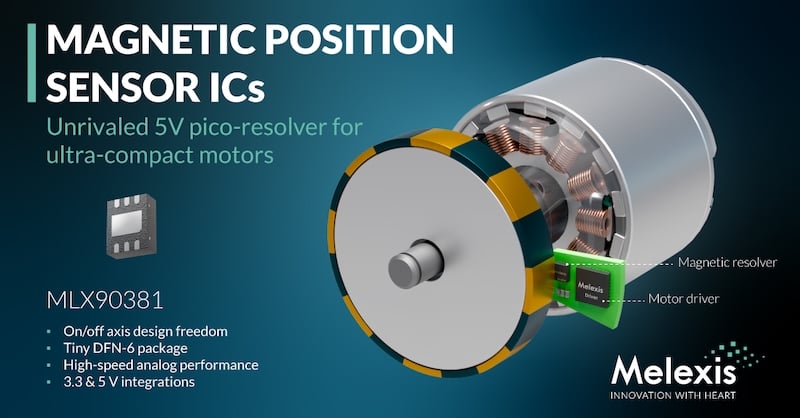
The MLX90381 5V targets automotive, alternative mobility, and robotics motors.
The part reads magnetic flux in three axes, refreshes its analog sine and cosine outputs every 2 µs, tracks rotational speeds above 50,000 rpm, and fits in a DFN-6 package measuring 2.0 mm x 2.5 mm x 1.0 mm. With it, Mexexis is targeting automotive, alternative mobility, and robotics motors that leave no room for a sensor at the end of the shaft.
Selectable Axis Pairs
Through-shaft motors, braking and steering actuators, e-bike drives, and compact robotic joints often leave no end-of-shaft real estate for a position sensor. That's where a conventional single-plane magnetic sensor needs to sit: on the rotation axis, where the magnet's field sweeps through its sensing plane. Meanwhile, the potential available workarounds add mechanical complexity or consume board area the design doesn't have left to spare.
The MLX90381 5V reads magnetic flux density on all three axes and maps any two of them—X/Y, X/Z, or Z/Y—to its outputs. Away from the rotation axis, the rotating field appears in a different pair of directions than at the shaft end, so selecting the pair that matches the mounting spot lets the sensor sit below or beside the magnetic track rather than on the axis itself.
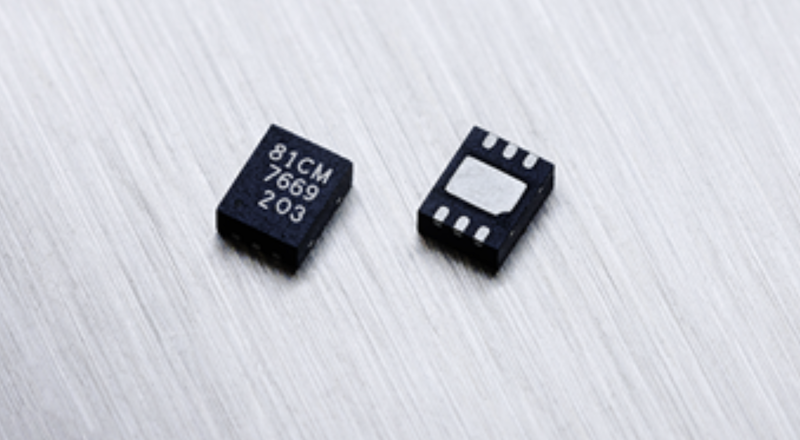
The MLX90381 magnetic pico-resolver IC.
Tunneling magnetoresistance parts, which Melexis names as the comparison point, typically read a single in-plane field direction, so a TMR die stays tied to on-axis placement and to tighter alignment tolerances between die and magnet.
Melexis branded the original MLX90381 the "world's first pico-resolver" at its June 2022 launch and paired it with its embedded LIN motor drivers, including the MLX81330/32 for flaps, valves, and single-coil fans and pumps, and the MLX81340/44/46 pre-drivers for higher-power loads such as blowers and window lifters. The 5-V variant extends that lineup rather than replacing it, with the 3.3-V part remaining in the catalog.
Analog Outputs
Like the original pico-resolver, the 5-V part outputs raw analog sine and cosine signals rather than a computed digital angle, keeping latency low and leaving angle calculation to the host microcontroller. Classic electromagnetic resolvers work the same way, and the arrangement fits field-oriented control loops that already run an arctangent in software.
The 2-µs output refresh and 50,000+ rpm rating leave headroom for rotor position feedback in DC, BLDC, and PMSM architectures. Sensitivity and filter bandwidth are both programmable, and an I2C interface handles configuration and calibration at end of line, so a single part number can be tuned across several motor variants during production rather than stocked in multiple flavors.
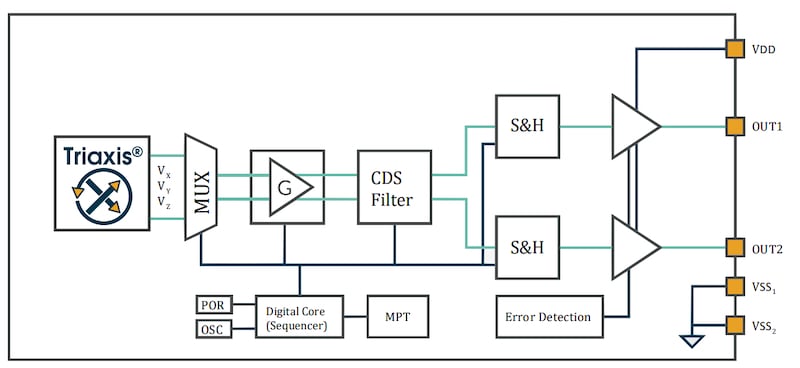
Block diagram of the MLX90381.
The original part offers two programmable sensitivity ranges: mid-field magnets from 10 mT to 70 mT and high-field magnets from 40 mT to 160 mT. The outputs are ratiometric, so the sine and cosine amplitudes scale with the supply the host ADC references, and the circuit needs only three external capacitors.
Operating temperature spans -40°C to 160°C, covering underhood and near-motor placement, and the device includes embedded diagnostics, AEC-Q100 qualification, and ASIL B SEooC capability under ISO 26262. Many automotive and industrial motor control boards run a native 5-V rail for gate drivers, current-sense amplifiers, and legacy peripherals. The 3.3-V-only original forced designers to add a regulator or route a second supply to the sensing position. Removing that requirement noticeably frees up board space.
Target Applications
Melexis lists e-valves, seat motors, door handles, braking motors, steering motors, e-bike motors, cadence sensing, and compact robotic actuators as target applications. The company is also positioning the part against large discrete electromagnetic resolvers with wound stators, moving resolver-grade feedback onto silicon small enough to sit on the control board next to the driver stage.
Wound resolvers persist in EV traction motors and electric power steering because they shrug off heat, vibration, and magnetic interference, but they require an excitation signal, dedicated windings around the shaft, and axial space measured in centimeters. None of that fits a seat motor or a door handle, which is the class of actuator Melexis is chasing here.
Compact actuators in collaborative arms and humanoid joints need absolute rotor position at high update rates, in packages that leave room for gearing and thermal management, and Melexis is now presenting the sensing approach it built for automotive actuation for those designs. E-bikes and light electric vehicles sit in similar territory, with cadence and rotor sensing squeezed into hub and mid-drive assemblies.
Related Content