Facebook
 Google
 GitHub
 Linkedin
Geehy Launches Encoder MCU Aimed at High-Precision Motion Control
Geehy didn't just tack encoder support onto a general-purpose MCU; the new "encoder MCU" is tailored for industrial servo systems, embodied robots, and intelligent automation equipment.
Geehy has expanded its industrial and motor-control portfolio with the G32R430, a microcontroller family designed specifically around encoder processing rather than treating it as a secondary task. The new devices target high-precision motion control systems such as servo drives, industrial automation equipment, and robotics platforms, where angle accuracy and low-latency feedback loops are central to system performance.
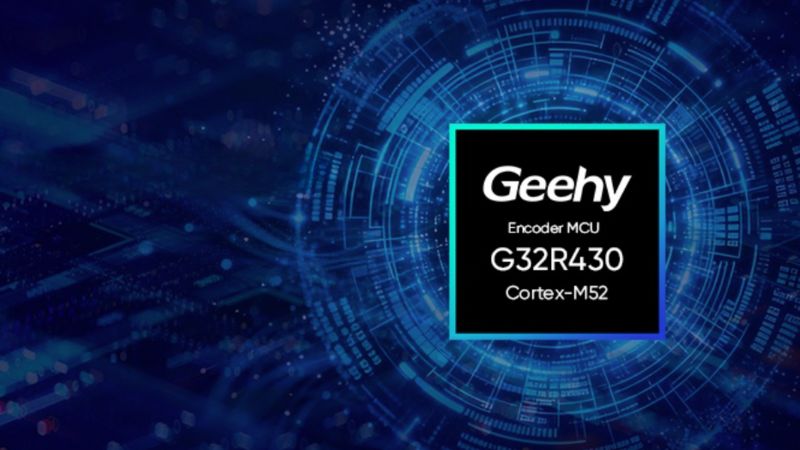
Rather than positioning the G32R430 as a general-purpose MCU with encoder support added on, Geehy is framing it as an “encoder MCU,” combining real-time compute, dedicated angle-calculation acceleration, and a signal acquisition subsystem tuned for sin/cos, magnetic, optical, and inductive encoder inputs. With these combined features, Geehy claims the device can reduce both algorithmic overhead and external analog circuitry in precision motion designs.
Built for Predictable Control Loops
At the core of the G32R430 is an Arm Cortex-M52 processor based on the Armv8.1-M architecture, running at up to 128 MHz. For motion control, raw clock speed is only part of the equation; just as important is how consistently the MCU can execute time-critical code. To that end, Geehy pairs the core with tightly coupled instruction and data memories (ITCM and DTCM), along with a small, high-speed cache, allowing critical routines to run with deterministic access times rather than relying on flash fetches with variable latency.
This memory architecture helps keep encoder sampling, angle computation, and control-law updates aligned to fixed time slots, even as firmware complexity grows. That matters in servo systems where jitter inside the control loop can degrade low-speed smoothness, increase torque ripple, or force designers to back off loop bandwidth for stability reasons.
The G32R430 family scales across multiple packages and pin counts, from compact 32-pin QFN options to larger UFBGA devices with up to 48 GPIOs. Flash and RAM configurations are sized for embedded motion workloads, with up to 128 KB of flash, 32 KB of ITCM, and 16 KB of DTCM available in the higher-end variants.
Hardware ATAN Acceleration
One of the most distinctive features of the G32R430 is Geehy’s proprietary ATAN electrical-angle computation instruction, implemented using a dedicated hardware math unit. In encoder systems that rely on sine and cosine signals, arctangent calculations sit at the center of angle extraction, mechanical-to-electrical angle conversion, and error compensation. Implemented purely in software, these operations can consume a significant fraction of the available compute budget and introduce variable execution time depending on code paths.

Block diagram of the G32R430.
By moving ATAN computation into hardware, Geehy is effectively targeting one of the most stubborn bottlenecks in high-resolution encoder processing. The company specifies electrical-angle accuracy better than 0.0001 degrees and sub-microsecond computation latency, which can materially reduce the time between analog sampling and usable position data.
That speed-up does more than just free CPU cycles. It tightens the overall timing envelope of the feedback loop, reducing the need to pad algorithms with guard time to account for worst-case math execution. In real systems, this can translate into higher control bandwidth, improved disturbance rejection, and more stable behavior at very low speeds, where latency and phase error are most visible.
Signal Acquisition Designed Around Encoder Realities
High-precision angle math only pays off if the input data is equally strong. The G32R430’s analog front end is built with encoder acquisition in mind, anchored by dual 16-bit ADCs that support both single-ended and differential inputs. Differential sampling is particularly relevant for sin/cos encoders, where common-mode noise and offset errors can directly corrupt angle calculations.
The ADCs support synchronous sampling modes using a master–slave configuration, helping ensure tight phase alignment between channels. Geehy specifies effective resolution of up to 13.5 bits in differential mode, with oversampling available to extend resolution further where bandwidth allows. The company also characterizes the MCU in terms of encoder capability, citing support for magnetic encoders at 17 bits or higher and optical encoders reaching 23-bit resolution, which provides useful context for system-level accuracy expectations.
Beyond the main ADCs, the G32R430 integrates a secondary 12-bit ADC, two DAC channels, and four programmable analog comparators. These blocks can absorb a range of support functions that often require external components, such as reference generation, threshold detection, window comparisons, and simple signal conditioning. A built-in temperature sensor enables thermal compensation of sensor characteristics, while supply-voltage monitoring supports robust startup and fault detection without extra analog hardware.
Ultimately, the G32R430 reflects a design philosophy that treats encoder processing as a first-class workload. By combining a deterministic real-time core, hardware-accelerated angle computation, and a signal-acquisition subsystem tailored for differential, high-resolution sensing, Geehy aims to reduce both software complexity and external analog overhead in precision motion systems.
Related Content