Facebook
 Google
 GitHub
 Linkedin
Branched Nanowires May Lend a Big Boost to LED Efficiency
A new material uses physical structure and material mix to direct photons out and minimize losses from internal reflection.
Researchers at Lund University in Lund, Sweden, have published a paper covering a new type of light-emitting diode that shows promise for significantly improving solid-state lighting efficiency.
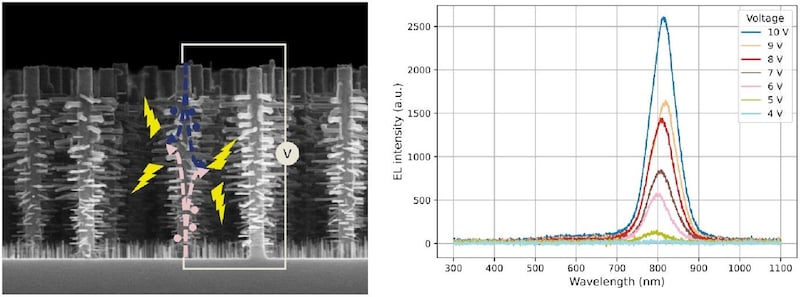
Charge carrier diffusion-induced nanowire light-emitting diodes and voltage-based performance.
The new LED relies on semiconductor nanowires (NWs) grown in a structure that avoids trapping photons. It further utilizes direct- and indirect-bandgap materials to control where photons are emitted.
The Limit to Conventional LED Efficiency
LEDs are often considered a very efficient light source—and they are when compared with other illumination types, such as incandescent and fluorescent sources. However, the stand-alone reality is a bit different. Due to a phenomenon called internal reflection, as little as four percent of the generated light escapes the LED material.
LED semiconductors have a high index of refraction, which means photons must strike the material's surface within a fairly narrow angle of incidence (typically 16° to 25°) to escape. Outside of that angle, the photons are reflected inward and bounce around inside the material. They are reabsorbed by another atomic bandgap or lost to phonons (quasiparticles made up of quantized collective atomic vibrations), converting them into waste heat. Today’s LEDs use complex surface treatments to improve photon escape percentages.
In a conventional LED, electrons move through the semiconductor, emitting photons along the way. Photons too far from the surface are reabsorbed instead of being emitted as light energy, as stated above. The Lund material utilizes an indirect-bandgap semiconductor material to move electrons internally without emitting photons and thin direct-bandgap NWs to emit photons. The direct-bandgap NWs are thinner than the wavelength of the emitted light and are thus too small for the photons to be internally reflected.
Charge Carrier Diffusion-Induced Nanowire LED
The new gallium indium phosphorous (GaInP) material utilizes epitaxially grown NWs. The charge carrier core of the grown structure, shown below, demarcated as “I”, is made with an indirect bandgap semiconductor grown on a p-type indium phosphorous (InP) substrate, demarcated as “p.”
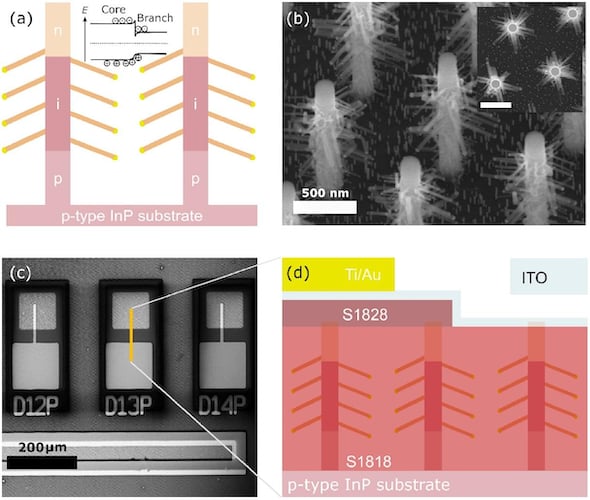
New LED material structure.
It passes electrons with minimal photon emission. The core is capped with n-type, indirect-bandgap material. A transparent indium tin oxide (ITO) layer on top completes the circuit.
Direct bandgap branch NWs extend from the core and emit photons. The branch NWs are smaller than the wavelength of the emitted light. As such, photons cannot be reflected inward and must exit the material. Since the core is an indirect bandgap material, photons cannot be easily absorbed into the core either.
Promise for Lighting Applications
The paper did not directly compare the new device with conventional LED efficiency. However, Magnus Borgström, professor of solid-state physics at Lund University, stated: “If the structures are made thin enough–thinner than the wavelength of light–the light cannot be trapped inside the material in the same way. Theoretically, this could enable a very high light output. In principle, it would be possible to release virtually all the light.”
Such an improvement could reduce costs by eliminating most surface treatments and lowering the power needed to generate an equivalent light level.
Work Still to Do
The devices can be made with near-standard epitaxial processes, but work remains. According to the paper, the relatively high voltages required indicate voltage loss throughout the structure. Substituting a direct-bandgap core (charted below) causes multi-spectra emission, which is less desirable for many applications.
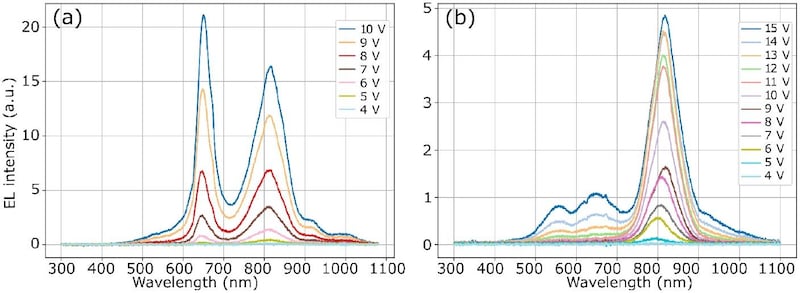
Spectra and intensity vs. voltage comparing (a) a direct-bandgap core with (b) an indirect-bandgap core.
An indirect-bandgap core gives much greater spectra control. The blue lines show that at a sufficient voltage, even the indirect-bandgap material begins to emit photons. The team wants to further improve surface characteristics, base conductivity, and direct-to-indirect-bandgap contact performance.
All images used courtesy of Sciopen.
Related Content