Facebook
 Google
 GitHub
 Linkedin
Arm Unwraps Automotive Compute Platform Aimed at ‘AI-Defined Vehicles’
Unveiled today, the new Arm Zena CSS platform reduces time to develop AI-based automotive control systems.
Today, Arm announced its first-generation Zena Compute Subsystems (CSS) platform for AI-vehicle design. The Zena CSS platform is pre-integrated and pre-validated to reduce silicon development time by up to 12 months, cut 20% from required engineering resources, and deliver a faster time-to-market.

Arm Zena CSS based AI-Defined Vehicle experience
The platform leverages broad deployment of Arm technology across the automotive industry to create a standardized system to deliver a highly capable AI-defined vehicle experience. Arm states that Zena CSS: “brings together verified, low power, high performance IP, a dedicated Safety Island and Runtime Security Engine, reference firmware, and software support into a complete CSS that is ready for silicon implementation.” Arm estimates that porting from platform to platform will require 30% less effort.
Artificial Intelligence and the AI-Defined Vehicle
The promise of automotive artificial intelligence (AI) lies in safety, convenience and efficiency. In an AI-defined vehicle, AI is intrinsic to the computing systems built with AI and the AI heavily influences all aspects of the driver and passenger experience. “AI-defined vehicle” covers feature sets like real-time driver monitoring, predictive maintenance, adaptive in-vehicle infotainment (IVI), and advanced driver assistance systems (ADAS).
The Arm Zena CSS is designed to evolve vehicle platforms beyond “software defined” to the stage of “AI-defined.” AI-defined vehicles have:
- Sophisticated AI models for all major functional areas.
- AI is used to deliver innovative new capabilities to the vehicle.
- The base starts with software-defined infrastructure with AI used to extend capabilities.
The AI systems self-coordinate and manage all aspects of vehicle experience.
- AI-enhanced ADAS can better understand and adapt to varying driving conditions.
- In vehicle infotainment (IVI) systems deliver personalized intuitive experience for reduced distraction and greater comfort.
- Vehicle systems and controls better understand road and environmental conditions to improve performance, economy and safety as needed.
Such automations used to be relegated to high-end car models but are soon to be standard across lineups. The silicon at the core of Zena CSS is pre-validates and includes not just the AI but also in-the-field security and real-time safety processing.
Reducing the AI Development Burden for All Manufacturers
ADAS and AI systems require vast resources to ensure adequate situation coverage and effective responses. Not all automotive manufacturers have the free resources available to do the AI ADAS and IVI job right. This scenario can lead to extended development schedules or inadequate systems.
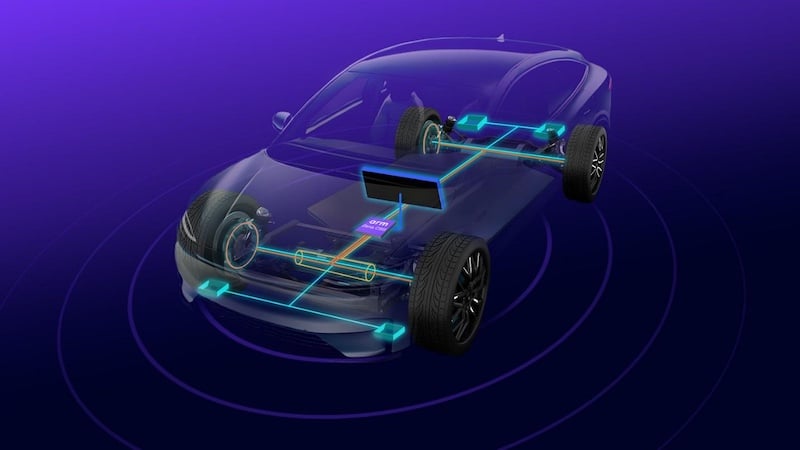
Arm is already used by 94% of automakers today.
Arm is well positioned to have a significant impact on AI-defined automobile initiatives due to their unique position amongst all automotive silicon vendors.
“Over 94% of automakers today use Arm technology, and the top 15 automotive processor suppliers use Arm technology,” said Dipti Vachani, Senior Vice President and General Manager of Automotive at Arm.
“100% of new entrants in the EV market use Arm technology.”
By creating a standardized platform that is pre-integrated and pre-validated, Arm Zena CSS will allow advanced capabilities to be integrated into automotive platforms faster and with industry-wide consistency.
Arm Zena CSS by the Numbers
The platform starts with Armv9 Automotive Enhanced (AE) technology. Armv9 is Arm’s newest architecture and is focused on AI, advanced security. and increased performance. The Zena CSS silicon comes with:
- 16 Armv9 Cortex-A720AE cores, performance optimized for ADAS and IVI applications
- Cortex-R82AE powered Safety Island, unique to Zena CSS and used for real-time ASIL D processing capabilities such as fault management, safety monitoring, system control, and SoC boot
- Runtime Security Engine with safety-capable Hardware Root of Trust (RoT), leveraging Arm TrustZone technology to manage SoC-level security
- CPU coherency and chip-to-chip connectivity provided by CMN S3AE
- Optional Image Signal Processing powered by Mali-C720AE and Mali GPU for ADAS use-cases, including surround view and driver-monitoring
- Support for easy integration of accelerators and partner-specific logic to meet evolving workload demands for advanced, AI-capable SoC design
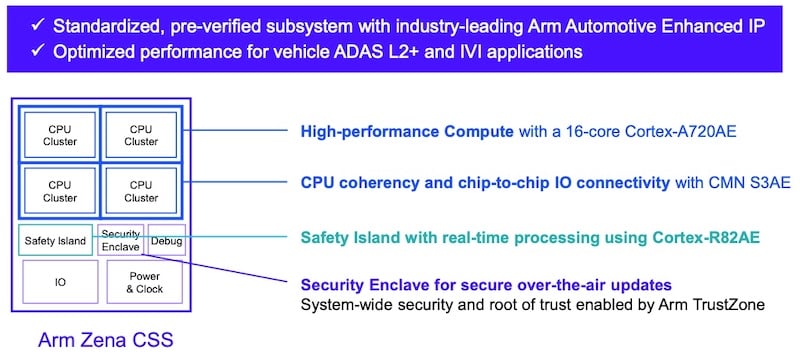
Arm Zena CSS block diagram
The software stack includes reference software and plug-and-play modules to allow for brand customization. Zena CSS is based on the SOFI standard, giving the platform four years of development in place.
Availability
Arm has available Zena CSS virtual platforms to allow software development to start today. The Zena CSS is shipping to select partners now and is slated for general availability in September 2025.
All images used courtesy of Arm.
Related Content