Facebook
 Google
 GitHub
 Linkedin
AMD Unveils Processors, Boards, and Dev Platform—All Tuned for Physical AI
Announced today, the new Ryzen AI Embedded X100 Series and Kria AI platform unify CPU, GPU, and NPU compute to provide the low-latency performance and deterministic control required for advanced physical AI robotics.
Today, at its Advancing AI 2026 event, AMD announced its new Ryzen AI Embedded X100 Series processors alongside the AMD Kria AI Solutions portfolio. Designed to meet the requirements of physical AI, the new hardware and software ecosystem brings perception, reasoning, and real-time control onto unified compute platforms for autonomous robotics, smart manufacturing, healthcare, aerospace, and defense applications.
To learn more about this news, I was pleased to speak with Rob Bauer, Senior Product Management and Marketing for x86 Embedded APU Portfolio at AMD, and KV Thanjavur Bhaaskar, Robotics Lead, Industrial, Robotics, and Healthcare Business Unit at AMD.
Heterogeneous Compute for the Physical AI Era
Physical AI systems require deterministic real-time control, low-latency AI inference, and multi-task orchestration while operating within tight power, thermal, and spatial envelopes. Traditional architectures often rely on separate CPU and discrete GPU boards (AI accelerators), introducing latency bottlenecks and synchronization delays across inter-chip buses.
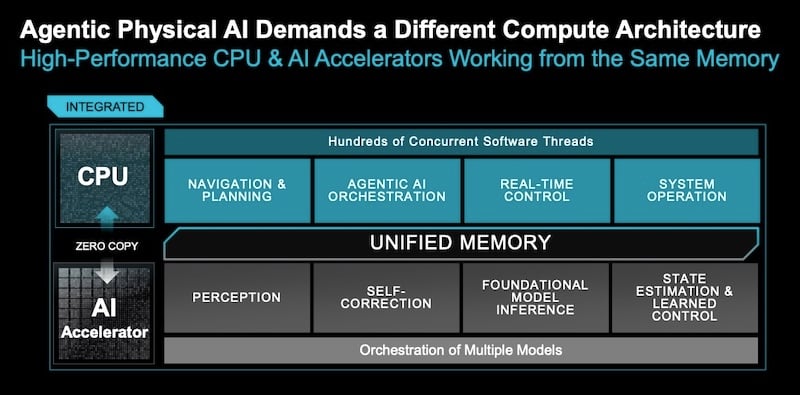
Physical AI demands a compute architecture where the CPU and AI acceleration are integrated and share a unified memory space.
“When these are two separate systems, communicating over something like PCIe or Ethernet, you're losing time in every single cycle, every time you have to handshake between the CPU and the AI accelerator,” says Bauer. “The solution to this problem is that physical AI needs a different compute architecture. It needs both the CPU and the AI accelerator integrated into one, but more importantly, it needs the data to be unified. And to do that, you need a unified memory architecture.”
With all that in mind, AMD's new Ryzen AI Embedded X100 Series processor architecture integrates CPU, GPU, and NPU compute engines onto a single system-on-chip (SoC) supported by a unified memory layout. This design minimizes explicit data movement across compute domains, increasing determinism for time-sensitive tasks in autonomous robotics, surgical equipment, and industrial automation.
Inside the Ryzen AI Embedded X100 Architecture
The Ryzen AI Embedded X100 Series pairs high-concurrency general processing with specialized parallel accelerators. The SoC architecture includes:
- CPU Engine: Up to 16 "Zen 5" x86 CPU cores dedicated to real-time control, system orchestration, and planning.
- Graphics & Signal Processing: An integrated AMD RDNA 3.5 GPU with discrete-class compute capacity for vision processing, rendering, and AI workloads.
- Neural Processing Unit: A power-efficient NPU optimized for continuous, low-power AI inference tasks.
- Memory Subsystem: A unified memory architecture designed to eliminate duplicate data copies across processing domains.
- Industrial Reliability: Qualified for -40°C to 105°C operating temperature ranges with support for continuous 24/7 operation up to 10 years.
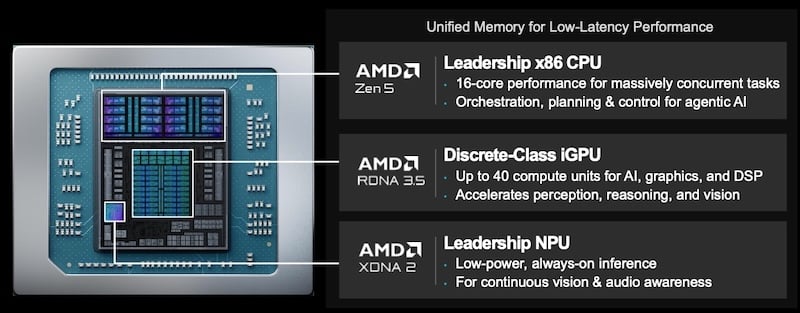
The AMD Ryzen AI Embedded X100 Series Processors combine computing for perception, reasoning, and control.
“The X100 has x86-class Zen 5 CPU, up to 16 cores,” says Bauer. “That handles the orchestration, planning, and control of the agentic system. Then we've taken essentially a discrete-class GPU and integrated it into the SoC. It offers up to 40 compute units that engineers can leverage for AI, graphics, and signal processing. It’s really the AI workhorse. And, finally, we've also integrated an NPU with XDNA 2 NPU. This NPU is really optimized around high performance per watt, for always-on inferencing and low power operation.”
Performance and Efficiency Benchmarks
Initial testing against competing embedded and mobile architectures highlights performance advantages across CPU, graphics, and AI workloads.
When compared to Intel Core Ultra Series 3 processors, the X100 Series achieves:
- Up to 2.1x higher multithread CPU performance on CoreMark v1.01 benchmarks.
- A 1.7x uplift in offscreen OpenGL graphics rendering.
- 3.5x higher token generation throughput with a 1.4x faster time-to-first-token (TTFT) on local LLM and VLM workloads.
In signal processing and medical ultrasound applications, the X100 Series delivers up to 3x higher peak FP32 performance than the Nvidia Jetson T5000 and an average 1.7x performance improvement in 128-channel beamforming compared to discrete Nvidia RTX 4000 Ada GPUs.
For autonomous robotics workloads running OpenNAV benchmarks against the Nvidia Jetson T5000, the platform demonstrates:
- Up to 3.4x higher real-time control reliability for on-time task execution.
- Up to 1.6x more spare CPU core capacity during active navigation.
- Capacity for up to 2.3x more concurrent AI agents executing agentic workflows.
From Body to Brain: The Kria AI Platform
AMD is extending its adaptive computing footprint from robot body components—such as joint control, sensor interfaces, and safety spines—to the main robot brain.
The AMD Kria AI System-on-Module (SOM) packages the Ryzen AI Embedded X100 Series onto an open-standard COM-HPC form factor. Designed for modular production deployment, the SOM provides a deterministic 125 µs CPU control loop rate (equivalent to 8,000 control decisions per second) while concurrently executing sub-100 ms vision-language-action (VLA) AI reasoning models.
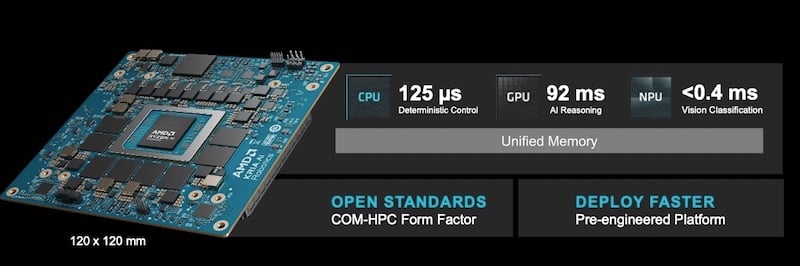
The Kria AI System-on-Module (SOM) sports the Ryzen AI Embedded X100 Series in an open-standard COM-HPC form factor board.
To accelerate early development, AMD introduced the AMD Kria AI Robotics Developer Platform. This turnkey evaluation kit integrates the X100-based Kria AI SOM, a specialized robotics carrier card equipped with GMSL camera inputs, high-speed Ethernet, Wi-Fi, and an IMU, along with baseboard FPGA logic for sensor fusion and custom real-time I/O.
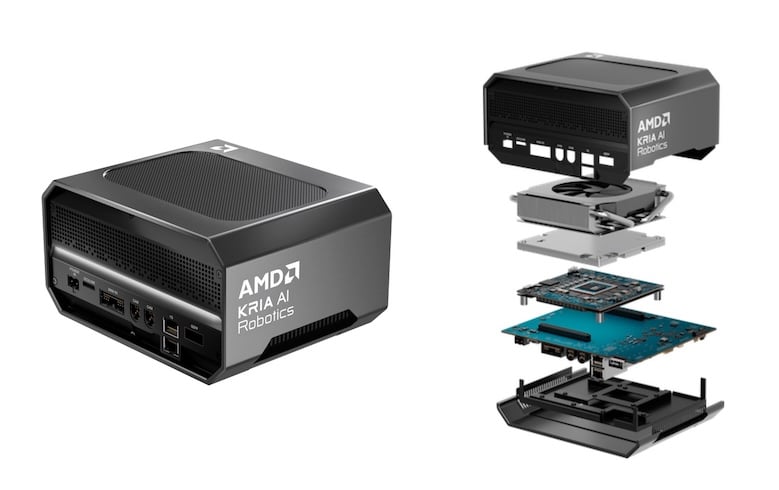
The Kria AI Robotics Developer Platform. The breakout view on the right shows the Kria AI SOM inside the box.
KV Thanjavur Bhaaskar breaks down the key elements of the developer platform. “The Kria IA SOM gives you the compute, and then to go with that we have a carrier card,” says Bhaaskar. “The schematics of the carrier card is going to be completely open, so you're not starting from scratch. And the carrier card has the right interfaces to power a robot—like, for example, GMSL camera interfaces, high-speed Ethernet, an IMU, and Wi-Fi.
It's the FPGA story that really makes the platform unique, says Bhaaskar. “The unique differentiation for AMD compared to any other company is that we also have FPGAs in our portfolio,” he says.
“If you look at the processors in the market today, where they are going to be capped on is the amount of sensors they can connect to and the type of sensors—the amount of sensor fusion they can do, as well as the real-time control. The FPGA on the carrier card solves those challenges.”
Open Software Ecosystem and Migration Tools
To mitigate vendor lock-in, AMD Kria AI solutions support an open software stack built around Linux, ROS 2, MoveIt, PyTorch, ONNX, and TensorFlow.
GPU workload acceleration is driven by the AMD ROCm open-source software stack. To assist developers transitioning from proprietary ecosystems, AMD provides code migration tools that automate the porting process, enabling engineers to retain an average of 75% of existing CUDA code when converting to ROCm and HIP constructs.
Virtualization and workload isolation are enabled through the Xen Hypervisor, allowing developers to execute hard real-time tasks alongside general-purpose operating systems on a single board.
AMD Robotics Partner Network
At Advancing AI 2026, AMD also announced the AMD Robotics Partner Network, an open ecosystem program designed to streamline the development, validation, and deployment of physical AI and autonomous robotics systems. The program connects original design manufacturers (ODMs), independent software vendors (ISVs), sensor and perception companies, simulation providers, safety and benchmarking partners, and system integrators onto a unified foundation built on open standards and tools.
Partners build and optimize systems across frameworks and software stacks including ROS 2, AMD ROCm, Ryzen AI, Vitis AI, and ONNX, allowing original equipment manufacturers (OEMs) to transition from reference systems—such as the Kria AI Robotics Developer Platform—to production without vendor lock-in.
Availability
Customer sampling for the AMD Ryzen AI Embedded X100 Series processors and early-access evaluation kits for the Kria AI Robotics Developer Platform are currently underway. Production availability for the X100 processors, Kria AI SOMs, and developer platforms is expected in the fourth quarter of 2026.
Commercial System-on-Modules based on the X100 architecture will be supplied by launch partners including Arbor, Congatec, iBase, IEI, Sapphire, and Seavo.
All images used courtesy of AMD.