Facebook
 Google
 GitHub
 Linkedin
Ambiq Rolls Out Two SoC Series Targeting Edge AI Applications
The six new chips offer a wide range of connectivity and graphics options for wearables, hearables, AR devices, health monitors, industrial sensors, and beyond.
Ambiq recently announced the availability of two new edge AI system-on-chip (SoC) product lines: the Apollo330 Plus and Apollo510 Lite. The series, including six variants, is built on Ambiq’s proprietary Subthreshold Power Optimized Technology (SPOT) low-power platform to deliver Arm Cortex-M-level performance with reduced power consumption. The SoCs promise 16x faster operation with 30x AI energy improvement over prior-generation Cortex-M processors running AI workloads.
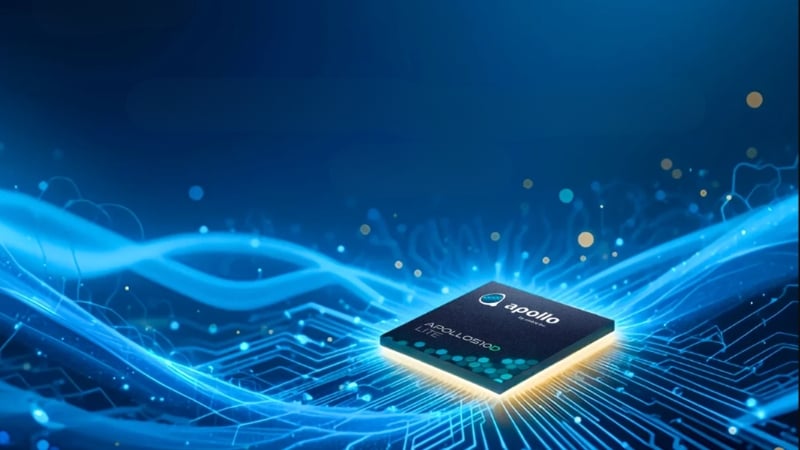
Ambiq’s new line of SoCs targets low-power scalable edge AI.
Ambiq is targeting the SoCs at edge AI applications that need both high-performance and long battery life, such as wearables, industrial sensors, and health monitors. The focus on AI capability and low power consumption makes the SoCs well suited to battery-operated devices that need AI capability without requiring constant cloud connectivity. The Apollo510 Lite targets applications requiring display acceleration, and the Apollo330 Plus series adds additional Bluetooth and Bluetooth audio capability.
The Family's Key Features
The family members—Apollo330 Plus, Apollo330B Plus, Apollo330M Plus, Apollo510 Lite, Apollo510B Lite, and Apollo510D Lite—are all driven by an Arm Cortex-M55 at up to 250 MHz with two 32-KB cache banks and 256-KB tightly coupled memory (TCM). The SoCs follow that with 1.75 MB of SRAM and 2 MB of NVM.

Apollo330 Plus series architecture.
The SoCs use an Arm Helium AI accelerator and Arm TrustZone security technology for AI and safety in edge devices. The AI processing delivers up to 8 multiply-accumulate (MAC) operations per cycle. The wireless system runs on a dedicated Cortex-M4 core at up to 96 MHz with 64 KB of TCM and an 8-kB code cache.
Apollo510 Series Adds Video and Security
The Apollo510 Lite series adds a video display subsystem consisting of a 2.5-D graphics processing unit (GPU), display controller, and MIPI DSI and QSPI display interfaces. The 510 also includes additional security over the 330 with secure boot, secure assets, a crypto accelerator, a true random number generator (TRNG), physical unclonable function (PUF), and locked MCU recovery.

Apollo510 Lite series architecture.
The Apollo330B Plus and Apollo510B Plus Lite include Bluetooth LE 5.4, while the 330M Plus and 510D Lite add classic Bluetooth. The 330M Plus also adds Thread and Matter compatibility.
Subthreshold (SPOT) Computing
Most semiconductors require at least one volt to reliably turn a transistor on. Subthreshold semiconductors operate below one volt. Ambiq uses proprietary techniques to produce SoC chips that reliably operate down to 300 mV. Since dynamic power consumption is proportional to the square of the voltage (E = C x V2), SPOT can deliver considerable savings in power consumption and thus extended battery lives for devices powered by the chips. Ambiq’s technology reduces leakage enough to reliably operate the SoC at speeds up to 250 MHz in the subthreshold regime.
Low-Power Audio
The chips utilize stereo pulse density modulation (PDM) for low-power, always-on audio listening from a digital microphone interface (DMIC), connecting to the rest of the chip over full-duplex I2S. PDM comes with good noise immunity, a simple two-signal (clock and data) interface, and low power consumption.
PDM is a one-bit encoding that increases the density of one bits as audio amplitude goes up and zero bits as amplitude goes down. The encoding is typically clocked at 1–3 MHz with a 64-bit oversampling ratio.
Availability
The SoCs come in packages as small as 4.0 mm x 4.0 mm with 68 GPIOs. They are also available in a 5.3-mm x 5.3-mm package with 120 GPIOs. The Apollo330 Plus and Apollo510 Lite SoC Series are now available in production quantities.
All images used courtesy of Ambiq.