Facebook
 Google
 GitHub
 Linkedin
Altera Unveils a New Agilex FPGA Portfolio and Agentic AI Developer Tool
Announced today, Altera has a new FPGA portfolio along with an AI expert companion designed to accelerate development for next-generation digital and physical AI fabrics.
Today, at its global Innovators Day developer event, Altera announced the Agilex 2X FPGA and SoC portfolio. The new programmable logic lineup is optimized to address the evolving demands of intelligent systems, spanning from edge robotics to cloud computing. Concurrently, the company launched QuartusIQ, an agentic AI developer companion available for download within the Quartus Prime 26.3 software suite.
The Interconnect Challenge: Scaling for Physical and Digital AI
As artificial intelligence workloads grow and edge-based robotics demand faster reflexes, traditional networking and compute architectures face rigid physical constraints. Designing systems for physical AI requires balancing complex heterogeneous compute environments with deterministic, low-latency processing and functional safety.
"Here you're seeing really complete grip ups of architecture in order to lay out, you know, add in the intelligence layer needed for those applications," said Lux Joshi, Senior Director of Product Management at Altera. "And this is perfect for an FPGA."
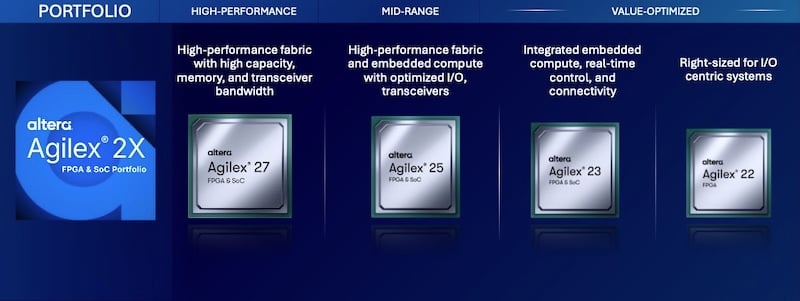
Altera’s new Agilex 2x FPGA portfolio
To target varying points on the power-to-performance spectrum, the new Agilex 2X portfolio scales across four distinct families:
- Agilex 27: High-performance FPGAs focused on processing- and bandwidth-intensive applications such as 6G, terabit networking, and beamforming.
- Agilex 25: Mid-range FPGAs balancing a high-performance fabric with embedded compute, optimized I/O, and transceivers tailored for video processing and low-latency sensors.
- Agilex 23: Value-optimized FPGAs integrating embedded compute, real-time control, and functional safety specifically suited for robotics and industrial automation.
- Agilex 22: Right-sized, high-I/O density FPGAs tailored for interface-bridging, motor control, and rack control systems.
Inside the Agilex 27 High-Performance FPGA
The first family to launch within the new architecture is the Agilex 27, targeting digital AI infrastructure, terabit networking, satellite communications, and aerospace and defense applications.
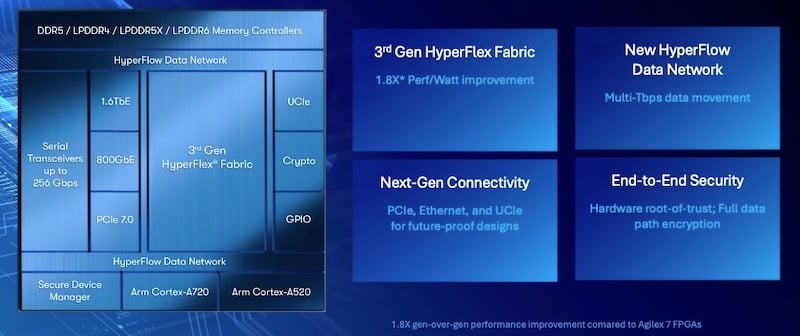
Altera’s Agilex 27 FPGA block diagram
Key technical characteristics of the Agilex 27 include:
- 3rd Generation HyperFlex Fabric: By embedding registers throughout the routing fabric, this architecture enables advanced pipelining and re-timing, achieving a 1.8x performance-per-watt improvement compared to previous-generation Agilex 7 FPGAs.
- HyperFlow Data Network: Operating as a distributed, on-chip data network, HyperFlow moves multi-terabit-per-second traffic across external interfaces, memory, and the FPGA fabric without congesting routing paths or consuming soft logic. "So whatever essentially whatever you would do in the soft logic is now hardened in that hyperflow," Joshi noted.
- Next-Generation Connectivity: The devices feature hardened intellectual property (IP) for 800GbE and 1.6TbE Ethernet, PCIe 6.0 and 7.0, and memory interfaces including DDR5 and LPDDR5X/6. They also support Universal Chiplet Interconnect Express (UCIe) to enable future integrated chiplets, such as data converters for RF designs.
- End-to-End Security: A Secure Device Manager provides a hardware root of trust with post-quantum cryptography support. Datapath encryption secures major interfaces—including PCIe and Ethernet—at line rates.
QuartusIQ: Agentic AI for FPGA Design
To accompany the new silicon, Altera introduced QuartusIQ, an AI expert companion trained on over 20,000 internal documents, IP specifications, and design rules. The software supports familiar workflows natively through the Quartus Prime GUI or via a Model Context Protocol (MCP) connector integrating with Visual Studio and GitHub Copilot.
"It's like having a highly trained expert about FPGAs working side by side on your design," explained Joshi.
Developers can leverage frontier models such as ChatGPT, Claude, and Gemini, or utilize an on-premises open-weight model like Nvidia's Nemotron via a specialized agent runtime harness. The tool can interpret block diagrams or natural language constraints to automatically generate system architecture, prioritize iterations, and run functional simulations. This capability accelerates design creation by up to 10x and cuts total design cycle times by up to 1.5x.
QuartusIQ is available for download today alongside the Quartus Prime software version 26.3. Engineering samples for the Agilex 27 FPGAs are expected to become available in the second half of 2027.
All images used courtesy of Altera.