Facebook
 Google
 GitHub
 Linkedin
Alif Semiconductor Unveils $49 StartKit Platform for Edge AI Development
The new evaluation kits aim to lower the barrier for on-device AI development with Alif’s AI/ML hardware-accelerated Ensemble and Balletto MCUs.
Alif Semiconductor has launched a new line of evaluation boards designed to lower the barrier to entry for on-device artificial intelligence (AI) and machine learning (ML) inferencing. The new small-form-factor StartKit platform provides hardware-accelerated development capabilities for the company’s Edge AI-enabled Ensemble and Balletto microcontroller (MCU) families.
Priced at an MSRP of $49, the company says its StartKits are engineered to make advanced AI processing accessible for engineers designing battery-powered edge devices.
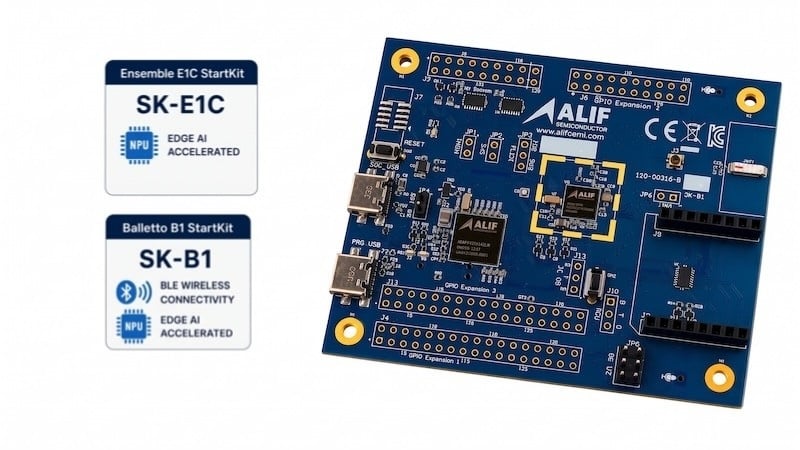
The two new StartKit boards are designed to make it easy for engineers to develop battery-powered AI edge devices.
To learn more about the new eval boards, I was pleased to speak with Henrik Flodell, Senior Marketing Director at Alif Semiconductor.
"We decided to pick our leading single-core devices—the Ensemble E1C devices and the BLE wireless Balletto B1 family,” said Flodell. “These MCUs contain an integrated NPU that does acceleration of either CNN or RNN type neural networks. We’ve populated those on small boards that we can provide to the market at an MSRP of less than $50.”
Superset Configurations and Processing Power
The StartKit family debuts with two distinct boards: the SK-E1C, targeting Alif’s Ensemble E1C devices, and the SK-B1, built around the BLE wireless Balletto B1 family.
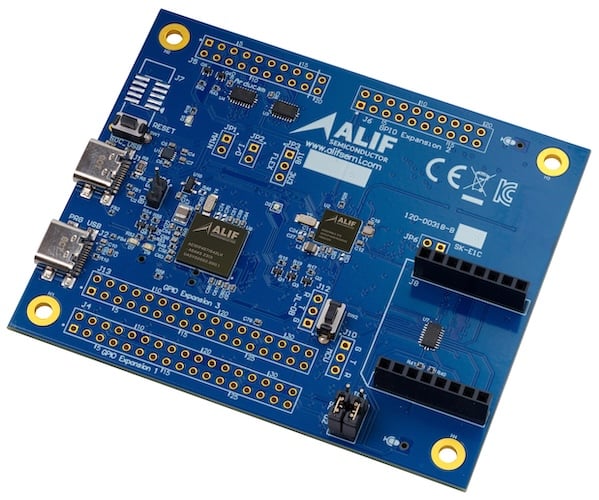
Ensemble E1C StartKit (SK-E1C)
Each board is equipped with the respective MCU series’ superset configuration. The processing architecture features a 160 MHz Arm Cortex-M55 CPU equipped with the Helium vector processing extension to accelerate digital signal processing (DSP) workloads. This CPU is paired with an Arm Ethos-U55 Neural Processing Unit (NPU), which can handle ML workloads up to two orders of magnitude faster than running the same algorithms on a standard CPU.
The StartKits provide ample memory for complex models, featuring 2 MB of onboard SRAM and up to 1.9 MB of non-volatile memory (NVM). To support data-intensive AI operations, the boards also incorporate off-chip octal SPI (OSPI) flash (64 MB) and PSRAM (32 MB).
Built for Prototyping and Expansion
Alif designed the StartKit platform to streamline hardware evaluation and accelerate the prototyping phase. The boards feature a custom 44-pin dual-row expansion header that exposes all MCU functions. Additionally, the StartKits integrate with established hardware ecosystems by providing support for Arduino R3 shields and MikroE Click boards, simplifying the addition of external sensors and peripherals.
Support for Arduino R3 shields and MikroE Click boards is about much more than the interfaces themselves. Rather it’s the fact that this opens up the StartKits to the whole ecosystems of those two families. The variety of MikroE Click boards is particularly vast.
Flodell agrees. “That's why we really like that MikroE interface,” he said. “But the interface is the interface—it's what they came up with. The important aspect is the fact that they actually have a substantial ecosystem of those kinds of modules. That’s in contrast with a lot of other add-on inventions from various platforms where they made an expansion connector, but never made very many expansion modules. So, MikroE Click boards are a great resource. And with Click boards, we can very easily cook up a driver to initialize it for our customers.”
To facilitate immediate testing of audio and vision-based ML models, both the SK-E1C and SK-B1 kits feature two onboard microphones and a camera module.
Other notable hardware features of the StartKits include:
- High-speed USB micro-B for data transfer and debugging
- USB-C port for power delivery
- Tri-color LED and a user-programmable button
- Clearly labeled current-sense jumpers for precise power profiling
- Integrated SEGGER J-Link On-Board debugger for seamless software development
For wireless applications, the Balletto SK-B1 variant includes an MCU with a Bluetooth Low Energy (BLE) 5.3 and 802.15.4 radio subsystem. To support this connectivity, the SK-B1 board is outfitted with a tuned chip antenna and a dedicated RF filter network.
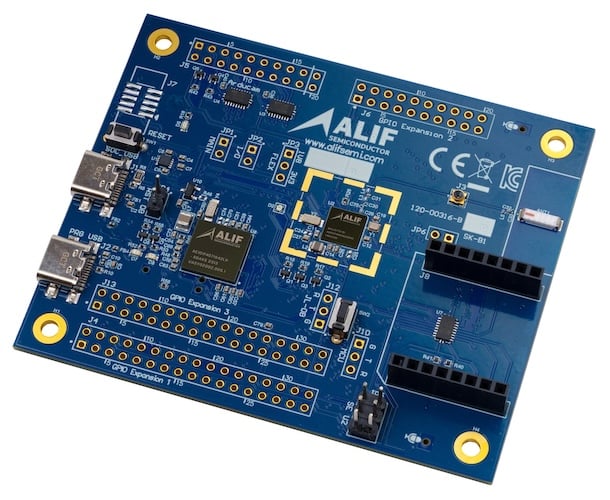
The Balletto B1 StartKit (SK-B1) sports the AI-enabled Balletto B1 MCU with BLE wireless connectivity.
Targeting Always-On Smart Devices
By integrating an NPU directly alongside a highly efficient MCU core, the Ensemble and Balletto chips aim to minimize power consumption while maximizing local data processing. This architectural approach keeps data on the device, avoiding the latency, bandwidth limitations, and privacy concerns often associated with cloud-based AI inferencing.
With the release of the SK-E1C and SK-B1 StartKits, it seems that developers now have an affordable, comprehensive hardware platform to prototype smart, always-on devices for consumer, industrial, and enterprise applications.
“Essentially what we want to do is to make sure that edge AI-capable microcontrollers can get into the hands of anybody who is interested in doing any level of experimentation with them—either in a connected environment or in a standard microcontroller-type package,” said Flodell.
All images used courtesy of Alif Semiconductor.