Facebook
 Google
 GitHub
 Linkedin
Agentic AI Takes the Stage at OCP Global Summit 2026
Intel, AMD, and Arm each made agentic AI announcements this week at OCP 2026, covering rack processor units, rack architecture, and benchmarking
AI processing today comes in more than one flavor. Training large language models (LLMs) requires massively parallel hardware repeating nearly the same calculation over and over. Inferential and generative AI compare input to the LLM or combine LLM tokens to create logically new material. Both are also highly repetitive operations utilizing limited input and human or programmatic operational guidance, but less repetitive than training.
Agentic artificial intelligence takes conventional AI and wraps it up in a shell of autonomy. Agents are given conventional tasks like scheduling, data analysis, reporting, health diagnosis, and other goal-oriented tasks. They complete the tasks with no or limited human intervention.
Agents require context awareness, adaptability, and the ability to interpret goals. Agentic AI combines inference AI and generative AI, with typically a lot more reading of complex multistep instructions. The result is different optimization requirements. It needs a balance of conventional computing for task routing and management, inference-optimization, generative capability, and the ability to deal with longer, more complex prompts.

Agentic AI was a major trend and theme this week at the OCP Global Summit. Image used courtesy of OCP.
The open compute project (OCP) encourages collaboration and interoperability between computing vendors. This week’s OCP Global Summit 2026 brought a focus on innovations directed toward agentic AI. This roundup from the summit covers agentic AI announcements by Intel, AMD, and Arm.
Intel Agentic AI GPU-D Series
Intel packaged up the GPU D-series with Xeon CPUs and an open software ecosystem for scaling enterprise-level agentic AI. The new GPU D-series, code named Crescent Island, is built on the Xe3P architecture and packaged up in an air-cooled PCIe 5.0 form-factor unit.
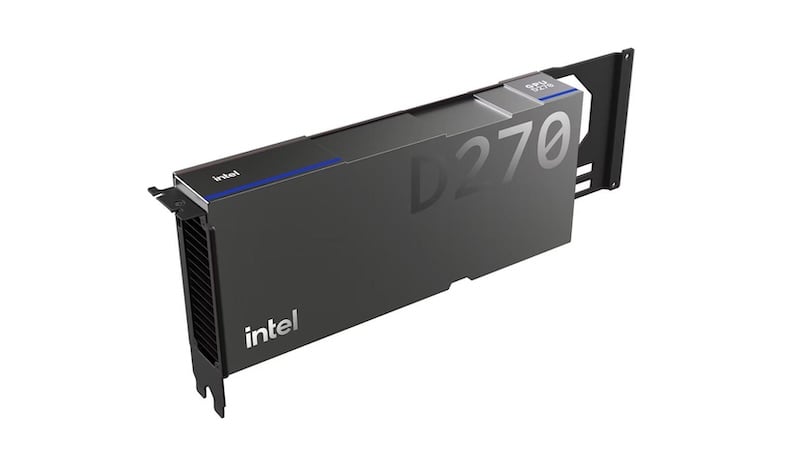
Intel GPU-D270 agentic AI processing unit. Image used courtesy of Intel
The GPU D270 includes up to 480GB of LPDDR5X with 1.5TB/s bandwidth. It includes 32 Xe3P cores and 256 XMX engines. This gives the unit FP8 processing at up to 1.3 petaflops. In addition to AI workhorses like FP8, INT4, and INT8, the GPU-D270 includes higher precision, up to FP64, hardware acceleration for scientific computing tasks.
The Xe3P architecture is derived from Intel GPU processing units but has the physical chip die rearranged to better accommodate the needs of AI matrix processing. XMX is Intel’s take on multiply-accumulate (MAC) hardware.
AMD Shows off Rack Scale Agentic AI
The AMD Helion systems offers user-customized configurations for rack-scale agentic AI deployment. As efficiency needs take a first-order role in conventional AI deployment, rack systems are becoming highly specialized with limited ability for system customization. AMD introduced the Helion rack system to counter that trend for agentic AI deployments.

AMD Helion configurable agentic AI rack system. Image used courtesy of AMD
Helion allows mixed rack configurations to accommodate a wide variety of agentic requirements. It can be deployed in an all-CPU configuration. It can also be deployed in all-GPU settings or with mixed configurations including CPU, GPU, and general-purpose compute cores all in one rack. Power and cooling can be customized as well, with both air- and water-cooled options available.
A single rack can hold up to 32,768 AMD EPYC x86 processor cores or up to 16 AMD Instinct MI350P GPUs in various combinations. It is capable of up to 103 Tbps of networking bandwidth.
Arm Takes Aim at AI CPU Evaluation Benchmarks
Arm brought its first foray into production silicon to OCP 2026, the Arm AGI CPU. The new processor was purpose built for agentic AI workloads. The CPU was demonstrated in Arm’s AGI CPU reference server and in Meta’s Yosemite YV5 open rack-scale platform. Arm announced a 2x improvement in work per rack over a comparable AMD EPYC 9755 rack system.
One of the problems with agentic AI is evaluating the efficiency of working systems. Conventional benchmarks are optimized for other types of AI and other types of computing tasks. Arm has the additional benchmarking challenge of being different from the x86 crowd. Along with the new platform, Arm introduced a new CPU evaluation methodology to benchmark its AGI CPU systems.
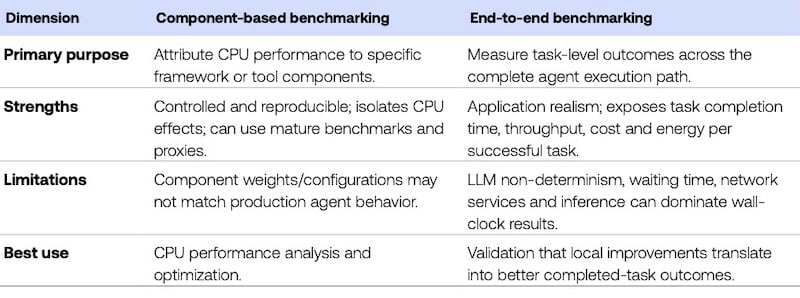
This table from Arm’s white paper shows the complementary roles of component-based and end-to-end benchmarking. Image used courtesy of Arm.
With new silicon and a new architecture, Arm joined with Fujitsu, Meta and OpenAI to develop a performance benchmark methodology that better evaluates agentic AI. Arm had their benchmark results independently verified by Signal65.
The new benchmark system evaluates agentic AI systems from three perspectives. It looks at the raw AI inference capability, supervisory CPU scheduling performance, and end-to-end work performance. This split covers theoretical performance in the AI processing, the utilization of AI performance due to scheduling and routing, and overall work-based final tally.